Consignment inventory costs MedTech 5-15% shrinkage and millions in disputes. Here's how to run a modern, real-time consignment programme in 2026 without replacing your ERP.
Consignment inventory, defined
Consignment inventory is stock that a supplier physically places at a customer's location, but retains ownership of until the customer consumes it. In MedTech, it's implants at hospitals, cardiovascular devices on surgical trays, orthopaedic kits at ambulatory surgery centres. In industrial and field services, it's spare parts at customer sites. In FMCG, it's promotional stock in retail trade.
The model is commercially brilliant - customers get zero-lead-time access to stock, suppliers get preferred-vendor status. Operationally, it's the most error-prone inventory model in the modern supply chain.
Why consignment breaks
Because the stock is physically at the customer's site, the supplier has:
- No direct line of sight to what's there
- No direct control over how it's used, stored, or rotated
- No automatic trigger for restocks, expiries or recalls
Most consignment programmes still rely on:
- Quarterly or monthly physical counts (when they happen at all)
- Rep-driven replenishment based on "what looks low"
- Spreadsheets and emails to reconcile what was used vs billed
The symptoms are familiar: stock-outs on critical SKUs, expired product bleeding margin, 5-15% shrinkage that nobody can trace, disputed consumption invoices, and - in MedTech - UDI/traceability gaps that fail audit.
The hidden cost, quantified
Across the consignment programmes we've audited:
- 30-40% of finished goods inventory sits on consignment in MedTech
- 5-15% typical shrinkage/loss rate on legacy consignment models
- 3-6% of consigned SKUs expire unused in a given year
- €200K - €2M in annual billing disputes for a mid-sized MedTech OEM
- 20-40% of rep time spent manually counting and restocking, not selling
And that's before you price in the compliance risk from EU MDR, FDA UDI and EUDAMED.
The four operating models
1. Manual / paper-based. Counts on clipboard, data typed into ERP later. 1970s. Still the default at a surprising number of global OEMs.
2. Spreadsheet. Shared Excel or Sheets. Better - but still hand-keyed, reconciled weekly, no real-time truth.
3. ERP field module. The ERP vendor's bolt-on. Typically 12-18 month deployments, 30-50% field adoption, and brittle through ERP upgrades.
4. Field inventory layer. A specialised, mobile-first platform sitting between the ERP and the field, built for this exact job. 4-8 week deployments, 90%+ adoption.
The economics of Model 4 are so dominant for companies above ~€20M in consigned inventory value that we expect it to become standard practice by 2028.
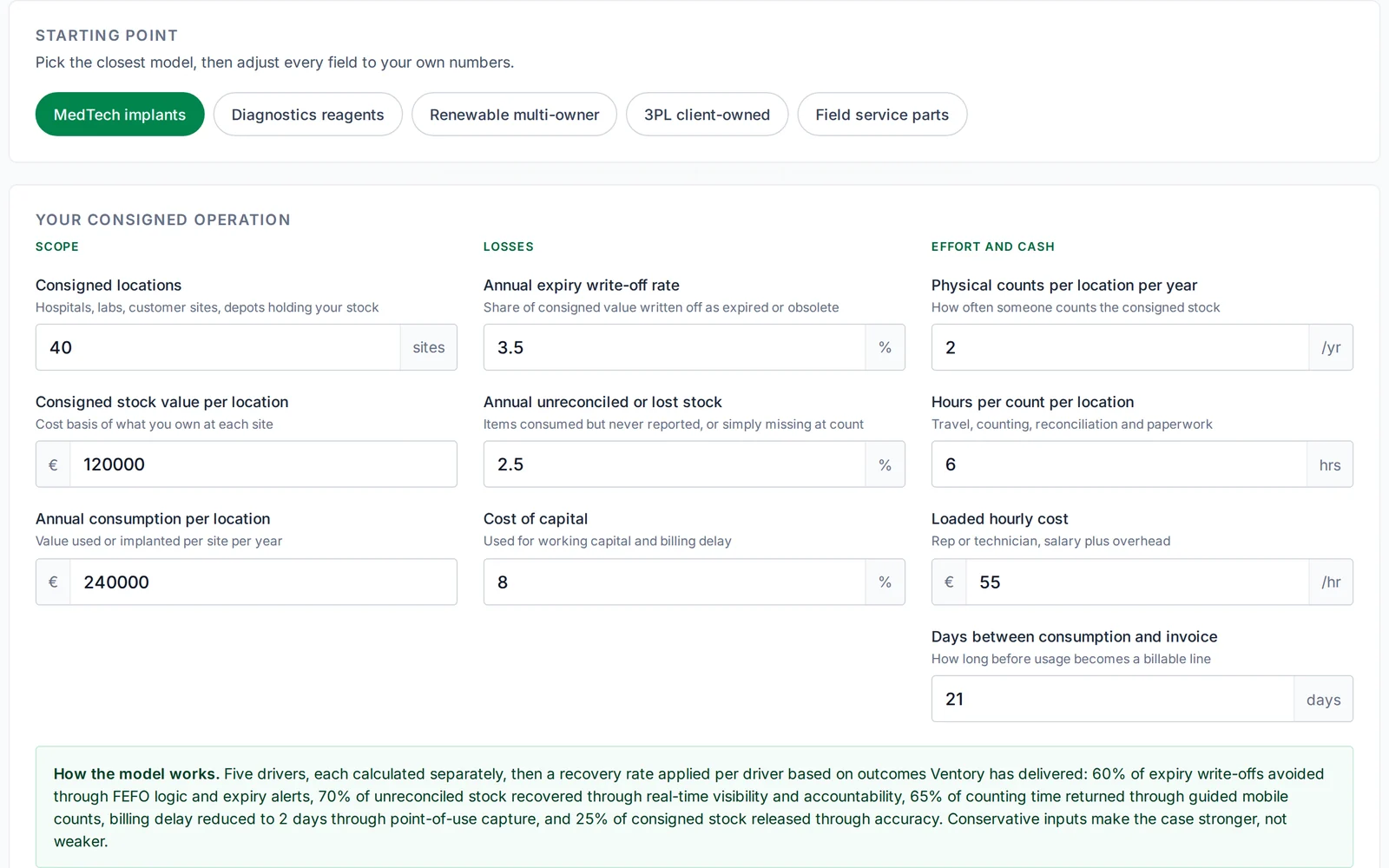
What a working field inventory layer does
Any serious consignment programme in 2026 needs seven capabilities:
- Real-time visibility of every consigned unit, by location, batch, expiry
- Scan-to-use workflows that take 5-10 seconds at the point of consumption
- Automated replenishment based on actual usage and min/max thresholds
- Lot/expiry management with automated rotation and expiry alerts
- UDI capture at the point of use, synced to ERP and EUDAMED
- Usage-based invoicing - bill from actual consumption, not estimates
- Recall readiness - pull every affected unit at every location in hours, not days
Integration, not replacement
The most important architectural point: a good field inventory layer doesn't replace your ERP. It extends it.
Your ERP (SAP, Oracle, Dynamics 365, BC, Sage, Infor, Manhattan, Blue Yonder) remains the system of record. The field layer captures what happens outside the warehouse - movements, uses, counts, transfers - and syncs it back. You get one source of truth, without a rip-and-replace.
The real-world reality check
A global medtech manufacturer runs consignment at hospital sites across Europe through Ventory - with UDI, lot and expiry captured in real time, 95%+ field adoption, and full sync back to their ERP. A national ambulance service achieved 99.76% stock accuracy across 100 ambulances with the same approach.
These aren't lab results. This is how consignment inventory works when it's done properly in 2026.
Getting started
If you run a consignment programme above ~€10M in inventory value:
- Quantify your current shrinkage, expiry waste and billing disputes - the business case almost always pays back in <12 months
- Pick one category, one vertical (e.g. Orthopaedic implants at your top 10 hospitals)
- Pilot a field inventory layer - target 4-8 weeks
- Measure adoption, shrinkage reduction and billing accuracy
- Scale from there
Running a consignment programme that's still spreadsheet-driven? Book a 30-minute diagnostic →
Frequently asked questions
What is consignment inventory?
Consignment inventory is stock that a supplier physically places at a customer's location but retains ownership of until the customer consumes it. In MedTech, it's typically implants, surgical kits, or cardiovascular devices at hospitals. In industrial and field services, it's spare parts at customer sites. Ownership transfers at the moment of use, which triggers billing.
How is consignment inventory different from vendor-managed inventory (VMI)?
VMI refers to who manages the replenishment decision - the vendor does, regardless of who owns the stock. Consignment refers to who owns the stock - the supplier does until consumption. Most modern MedTech programmes combine both: vendor-owned, vendor-managed, customer-located.
What are the typical costs of running consignment badly?
Across the programmes we've audited: 5-15% shrinkage, 3-6% of SKUs expiring unused, €200K - €2M in annual billing disputes for a mid-sized MedTech OEM, and 20-40% of rep time consumed by manual counts instead of selling. Plus UDI/MDR compliance exposure you may not see until a recall.
Do I need to replace my ERP to modernise consignment?
No. A modern field inventory layer connects to SAP, Oracle, Microsoft Dynamics, Sage, NetSuite, Infor and Manhattan as the ERP of record. The field layer handles real-time capture, mobile workflows and UDI; the ERP remains the system of truth for finance and fulfilment.
How long does a modern consignment rollout take?
Typically 4-8 weeks for a pilot at 3-5 sites and 3-6 months to scale across a category or region. Compare that to 12-18 months for an ERP field-module deployment.
About Ventory
Ventory is the field inventory layer for regulated, high-stakes industries. We give MedTech, 3PL, Aerospace, Energy and FMCG leaders real-time visibility and control over inventory outside the four walls - in hospitals, ambulances, trunk stock, consignment locations, and field service vans. Ventory is ERP-agnostic (SAP, Oracle, Dynamics, Sage, NetSuite) and trusted by a global medtech manufacturer, a national ambulance service, global logistics and consumer-goods operators. See how it works →
Ten questions. You get a field readiness score, a gap tier and the three fixes worth doing first.

Ventory is the field inventory layer between your ERP or WMS and the teams working outside the warehouse: engineer vans, forward stocking locations, consigned stock and loaner kits.
About Ventory