Every major ERP assumes inventory lives in the warehouse. But 20-40% of stock is in the field. Here's how the field inventory layer closes the ERP visibility gap.
The assumption that breaks every enterprise operation
Every ERP on the market - SAP S/4HANA, Oracle Fusion, Microsoft Dynamics 365, Sage Intacct, Infor, Manhattan, Blue Yonder - is built on the same foundational assumption: that inventory lives in the warehouse.
That assumption was approximately true in 1990. It is catastrophically wrong in 2026.
In the companies we work with, somewhere between 20% and 40% of finished goods inventory sits outside the warehouse - in field service vans, at consignment sites, in loaner kits, in ambulances, at retail trade locations, on engineer benches at customer sites. That stock is invisible to the ERP in any real-time sense. And that invisibility is where your operation bleeds money.
What "visibility gap" actually costs
The field inventory gap manifests in five places on your P&L:
1. Shrinkage. 5-15% of field inventory is typically unaccounted for over 12 months. At scale, that's 7- to 8-figure annual leakage.
2. Expiry waste. Lot-controlled goods expiring on customer shelves because nobody tracks rotation - 3-6% annually in regulated categories.
3. Stock-outs. Critical SKUs running to zero at the exact moment of need, because replenishment is triggered by the wrong signal (rep judgement, not consumption data).
4. Unbilled consumption. In consignment and loaner models, 3-8% of used goods never generate an invoice line. Pure margin giveaway.
5. Manual admin time. Hours of rep, engineer and ops time spent on counts, reconciliations and paperwork that should be automated. Quietly the biggest cost of all.
And - increasingly - the visibility gap is a compliance problem. EU MDR, FDA UDI and EUDAMED all require real-time traceability that your ERP simply cannot produce if a third of your inventory is in places the ERP can't see.
Why ERPs can't fix this themselves
The ERP vendors aren't unaware of this. Every one of them sells some form of "field module," "service module" or "mobile extension." Most enterprises have tried at least one. Most don't survive contact with reality.
The reason is architectural:
- ERPs are transactional, not event-driven. They want reconciled batches, not real-time streams.
- ERP UX is built for desks, not for scrub nurses, field engineers or ambulance crews.
- ERP customisation cycles are 6-18 months. Field operations need weeks.
- ERP upgrades break custom modules. Your field investment becomes tech debt.
Forcing your ERP to do the field layer is like forcing a spreadsheet to do CRM. You can make it work. You shouldn't.
The field inventory layer
The architecture that actually works in 2026 is a specialised field inventory layer sitting between the ERP and the field.
- The ERP remains the system of record. Finance, GL, master data, procurement - unchanged.
- The field layer handles everything outside the warehouse walls: consumption capture, consignment, loaner kits, trunk stock, van inventory, retail merchandising.
- Integration is two-way, real-time: the field layer pulls master data from the ERP, pushes transactions back to it.
- The user experience is mobile-first, offline-capable, role-based, built for humans who aren't logistics professionals.
You end up with one source of truth - without ripping out the ERP. That's the critical architectural insight.
What good looks like
We look for five capabilities in a field inventory layer:
- Real-time visibility of every unit outside the warehouse, by location, batch, expiry
- Sub-10-second transaction times for consumption, transfer, count
- Offline-first mobile that survives basements, remote sites, flaky cellular
- ERP-agnostic integration - SAP, Oracle, BC, Sage, Infor, Manhattan, Blue Yonder
- 90%+ field adoption - because anything below that means the data is still lying
The proof
Ventory is live today at leading medtech manufacturers, healthcare providers and logistics operators, across 450+ field locations. The measured outcomes:
- 99.76% stock accuracy at a national ambulance service
- 95%+ adoption from field staff
- 4-8 weeks deployment time
- <1% shrinkage on consignment and loaner programmes after 6 months
- Full integration with SAP S/4HANA, Dynamics 365 BC, Sage and Oracle
That's what closing the ERP gap looks like.
What to do about it
If you're an ops or supply chain leader in an enterprise where field inventory matters:
- Map the gap - what percentage of inventory value is outside the warehouse today?
- Quantify the bleed - shrinkage, expiry, unbilled consumption, admin time
- Don't wait for the ERP vendor - the architecture they're offering has a decade of track record and it doesn't work
- Pilot a field inventory layer in one vertical
- Scale from there
Your ERP implementation didn't fail. It just finished the first half of the job. Book a 30-minute diagnostic →
Frequently asked questions
What is the ERP visibility gap?
The ERP visibility gap is the 20-40% of finished-goods inventory that sits outside the warehouse - in consignment, loaner kits, field service vans, ambulances, trunk stock and retail trade - that your ERP cannot see in real time. Every major ERP was architected around warehouse-centric workflows; inventory in motion and at customer sites is effectively invisible to the system of record.
Why can't ERPs fix the field inventory gap themselves?
Three architectural reasons. ERPs are transactional rather than event-driven, so they want reconciled batches not real-time streams. Their UX is built for desks, not for scrub nurses or field engineers. And ERP customisation cycles run 6-18 months - too slow for field operations that need to iterate in weeks. ERP-vendor "field modules" typically hit 30-50% adoption and break on the next ERP upgrade.
What is a field inventory layer?
A field inventory layer is a specialised platform that sits between the ERP and the field. The ERP remains the system of record for finance, procurement and master data. The field layer handles everything outside the warehouse: consignment, loaner kits, trunk stock, van inventory, consumption capture and mobile workflows. Integration is two-way and real-time.
Do I have to replace my ERP to close the visibility gap?
No. The whole point of a field inventory layer is that it extends the ERP rather than replacing it. Ventory integrates with SAP S/4HANA, Oracle Fusion, Microsoft Dynamics 365 / BC, Sage Intacct, NetSuite, Infor, Manhattan and Blue Yonder. Master data flows in, transactions flow back - the ERP is still your single source of truth.
What kind of results do field inventory layers deliver?
In production at Ventory customers: 99.76% stock accuracy (a national ambulance service), 95%+ field adoption, under 1% shrinkage on consignment and loaner programmes after six months, and 4-8 week deployment timelines versus 12-18 months for ERP field modules.
About Ventory
Ventory is the field inventory layer for regulated, high-stakes industries. We give MedTech, 3PL, Aerospace, Energy and FMCG leaders real-time visibility and control over inventory outside the four walls - in hospitals, ambulances, trunk stock, consignment locations, and field service vans. Ventory is ERP-agnostic (SAP, Oracle, Dynamics, Sage, NetSuite) and trusted by a global medtech manufacturer, a national ambulance service, global logistics and consumer-goods operators. See how it works →
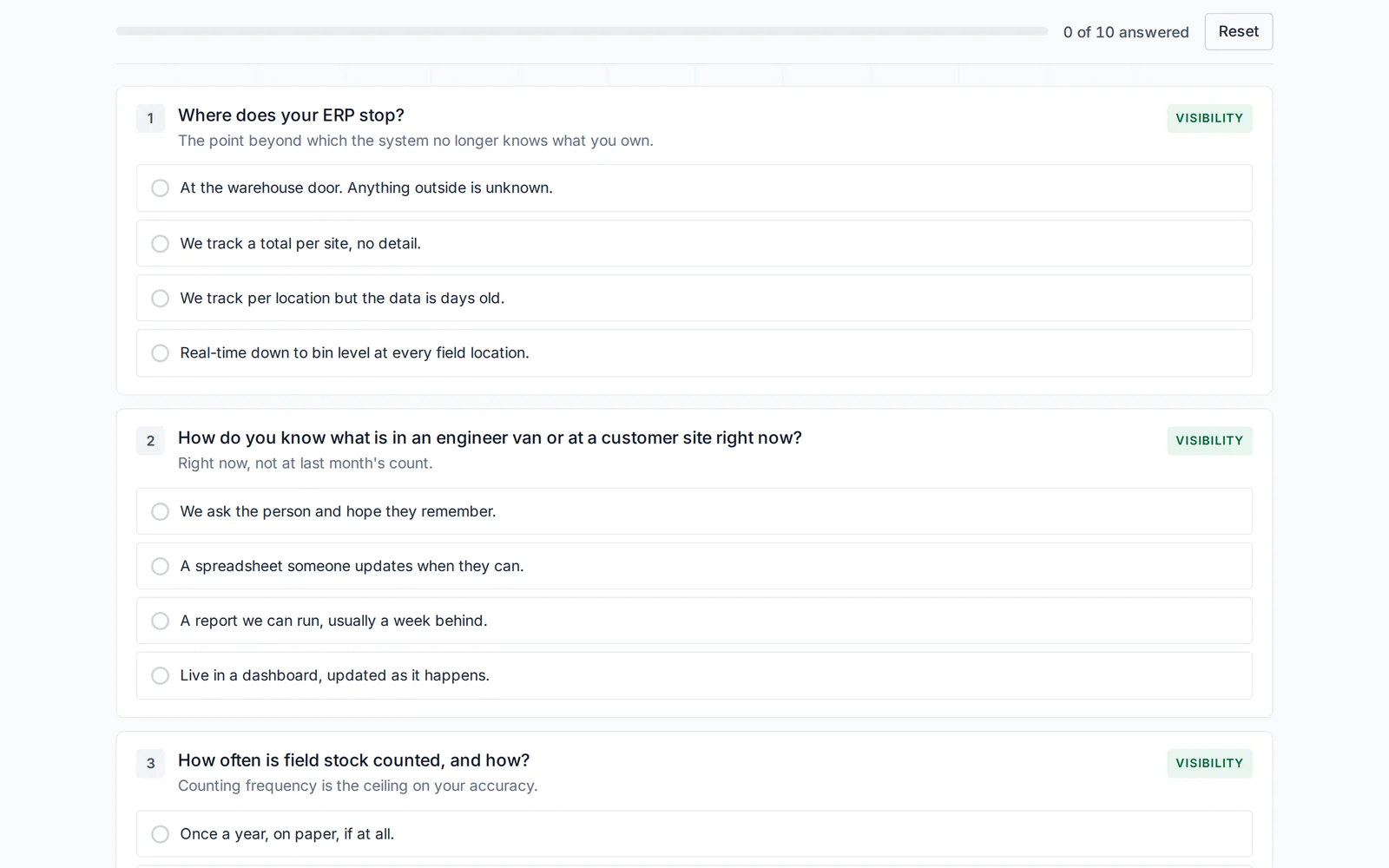
Ten questions. You get a field readiness score, a gap tier and the three fixes worth doing first.

Ventory is the field inventory layer between your ERP or WMS and the teams working outside the warehouse: engineer vans, forward stocking locations, consigned stock and loaner kits.
About Ventory