Loaner kits hide €3-€10M a year in shrinkage, expiry and unbilled consumption for mid-size MedTech OEMs. Here's how modern loaner kit management closes the gap in 6 weeks.
The most expensive inventory nobody tracks
A single orthopaedic loaner kit can hold €40,000-€150,000 of instruments and implants. A mid-sized MedTech OEM might run 500-2,000 kits in continuous circulation - between warehouses, surgical centres, hospitals and sales reps. That's up to €300M of inventory in motion at any given moment.
In most companies, it's tracked in a spreadsheet.
This is the hidden bleed in MedTech supply chains - and the part of the operation most exposed to EU MDR, FDA UDI and, after 28 May 2026, EUDAMED.
What actually goes wrong with loaner kits
We've mapped the loaner process at a dozen MedTech OEMs. The failure modes are remarkably consistent:
1. Incomplete returns. A kit goes out with 47 components, comes back with 44. Nobody notices for two weeks. The missing implants were either used (and not logged), lost in theatre, or walked off.
2. Cross-contamination between kits. A component from kit A ends up in kit B during a turnaround. Now both kits have wrong contents - and the next surgeon opens the sterile tray mid-procedure and discovers the problem.
3. Expiry creep. Single-use implants inside loaner kits expire in rotation. Without active tracking, 3-6% expire annually. In absolute terms: up to €5M in annual write-offs at scale.
4. Missed billing. An implant is used, the kit is returned, and the consumption charge never gets raised. Most OEMs we audit find 3-8% of used implants go unbilled.
5. Turnaround drag. Kits sit at the warehouse for 2-4 days being manually counted before they can go out again. That's dead capital.
Add it up, and loaner kit inefficiency typically costs a mid-sized OEM €3-€10M per year in pure operational waste - before you count the compliance and patient-safety risk.
Why the spreadsheet model persists
Because loaner kits move through chaotic, high-pressure environments:
- Theatres running late, ops booking same-day returns
- Reps loading vans at 6am for 9am surgeries
- Warehouses turning around 80 kits a day
- Components that are tiny, visually similar, and worth thousands
ERP transactions don't survive that environment. Email and Excel do - badly.
What a modern loaner workflow looks like
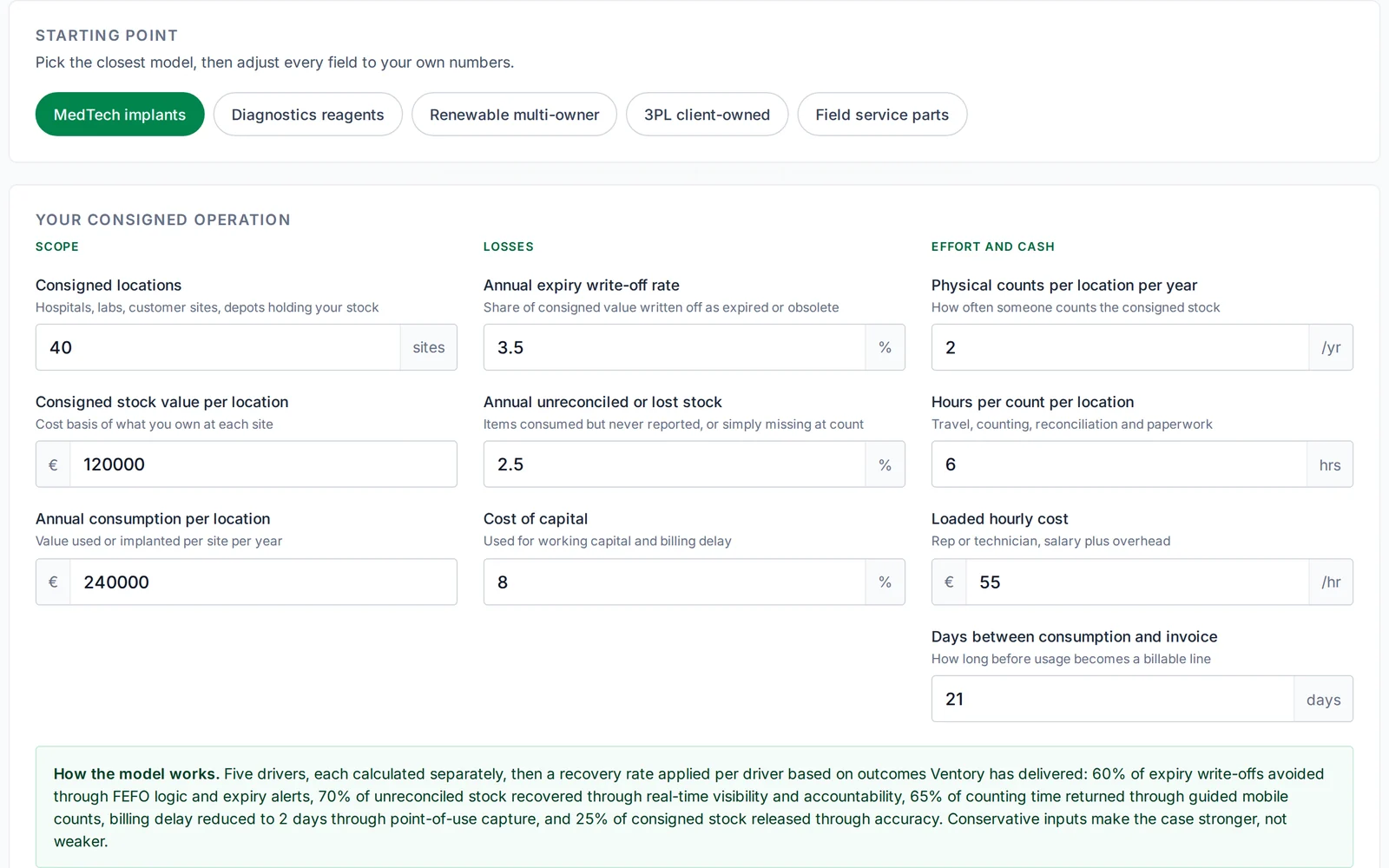
A working field inventory layer for loaner kits delivers five things:
- Kit master data - each kit has a digital fingerprint of exactly what it should contain, with UDI/lot/expiry
- Scan-to-ship and scan-to-return - pick the box, scan the kit ID, auto-verify contents in 30 seconds vs a 20-minute manual count
- In-theatre consumption logging - scrub nurse or surgeon scans used implant at the point of use, triggers billing and replenishment
- Turnaround automation - kit comes back, a single barcode scan reconciles it against master data, flags shortages and substitutions immediately
- Closed-loop billing and compliance - every used implant generates an invoice line and a UDI record, automatically
Do this and turnaround typically drops from 2-4 days to under 24 hours. Shrinkage drops from 5-10% to under 1%. Unbilled consumption approaches zero.
One platform, every stakeholder
The reason this works is that the same platform handles:
- Hospital staff logging consumption in 10 seconds
- Reps managing van stock and surgical bookings
- Warehouse running rapid turnarounds
- Ops and Finance seeing real-time inventory, billing and compliance dashboards
- IT getting clean, real-time data pushed into the ERP
Role-based, mobile-first, offline-capable, ERP-integrated. That's the architecture. Everything else is window dressing.
The Ventory footprint
Ventory is deployed across 450+ field locations for customers including a global medtech manufacturer, a national ambulance service, global logistics and consumer-goods operators. In MedTech specifically, we've seen:
- 95%+ adoption from field staff
- <1% shrinkage on loaner kits after 6 months
- 70% reduction in kit turnaround time
- 99.7%+ stock accuracy
- Full UDI/lot/expiry capture at point of use
What to do next
If your loaner programme is above ~500 kits:
- Quantify the bleed - shrinkage, expiry, unbilled consumption, turnaround time
- Pick one franchise (usually orthopaedics or spine) as the pilot
- Deploy a field inventory layer - target 6 weeks
- Measure, expand
The business case almost always pays back in under a year. The compliance upside is free.
Want a loaner kit bleed assessment? Book 30 minutes with our MedTech team →
Frequently asked questions
What is a loaner kit in MedTech?
A loaner kit is a tray of surgical instruments and, often, sterile implants that a MedTech manufacturer lends to a hospital or ambulatory surgery centre for a scheduled procedure. After the procedure, the kit returns to the OEM's warehouse where used implants are replaced, the tray is reconciled and it goes back into circulation. Loaner kits are standard in orthopaedics, spine, trauma and some cardiovascular franchises.
What does a loaner kit cost and how many does an OEM run?
A single orthopaedic loaner kit typically carries €40,000-€150,000 in instruments and implants. A mid-size MedTech OEM runs 500-2,000 kits in continuous circulation - up to €300M of inventory in motion at any moment.
Why is loaner kit shrinkage so high?
Loaner kits move through theatres, rep vans and warehouses under time pressure. Components are small, visually similar and expensive. Manual count processes miss discrepancies, components migrate between kits, and used implants routinely go unrecorded - so shrinkage of 5-10% is common and unbilled consumption runs at 3-8%.
Does loaner kit tracking tie into UDI and EU MDR compliance?
Yes. Every implant used out of a loaner kit has to be recorded against a patient and a lot/expiry under EU MDR, FDA UDI and (from 28 May 2026) EUDAMED. A modern loaner platform captures UDI-DI and UDI-PI at the point of use via GS1 DataMatrix scan, so compliance records are generated as a by-product of the workflow.
How long does it take to modernise a loaner programme?
Around 6 weeks to pilot on one franchise (typically orthopaedics or spine), and 3-6 months to scale across the full kit fleet. No ERP migration required - the field inventory layer connects to SAP, Oracle, Dynamics, Sage or NetSuite.
About Ventory
Ventory is the field inventory layer for regulated, high-stakes industries. We give MedTech, 3PL, Aerospace, Energy and FMCG leaders real-time visibility and control over inventory outside the four walls - in hospitals, ambulances, trunk stock, consignment locations, and field service vans. Ventory is ERP-agnostic (SAP, Oracle, Dynamics, Sage, NetSuite) and trusted by a global medtech manufacturer, a national ambulance service, global logistics and consumer-goods operators. See how it works →
Ten questions. You get a field readiness score, a gap tier and the three fixes worth doing first.

Ventory is the field inventory layer between your ERP or WMS and the teams working outside the warehouse: engineer vans, forward stocking locations, consigned stock and loaner kits.
About Ventory