Trunk stock is the hardest inventory problem in the enterprise - and costs mid-size field operations €1-€3M/year on spreadsheets. Here's how to close the gap in 6-8 weeks.
Trunk stock, explained
"Trunk stock" is the inventory your field teams carry with them - in sales rep trunks, engineer service vans, implant reps' travel cases, ambulance boots. It's the closest stock to the moment of use, and it's often the most critical stock in your entire operation. A first-time-fix on a customer site depends on it. A surgeon deciding which implant to use in theatre depends on it. A crew's ability to respond to a trauma call depends on it.
And in 2026, most of it is still managed on spreadsheets.
Why trunk stock is the hardest inventory problem in the enterprise
Trunk stock breaks every assumption traditional inventory systems make.
- It moves - every day, across geographies, sometimes across borders
- It's consumed without warning - an unplanned surgery, a breakdown call, a trauma response
- It's replenished under pressure - at 11pm in a car park, 6am before a shift, during a 20-minute lunch stop
- The person managing it isn't a logistics professional - they're a rep, an engineer, a paramedic
- The value per unit is high - a spinal implant is €15K+, a complex spare part €5K+
Any system that requires the rep to "reconcile at the end of the week" has already lost.
The spreadsheet tax
Most enterprises running trunk stock do so via:
- A shared spreadsheet per rep or engineer
- Periodic manual counts (weekly at best, monthly usually)
- Email-based restock requests
- Paper receipts stapled to consumption reports
- Central ops reconciling against the ERP once a month
The visible cost of that model is the admin time. The invisible costs are worse:
- Shrinkage at 5-15% of trunk stock value annually
- Expiry of lot-controlled goods sitting too long in a van
- Stock-outs at exactly the wrong moment - a lost deal, a failed first-time-fix, a delayed procedure
- Compliance exposure - UDI, controlled substances, high-value serialised stock with no real-time audit trail
- Rep and engineer time - hours per week on admin instead of revenue or service
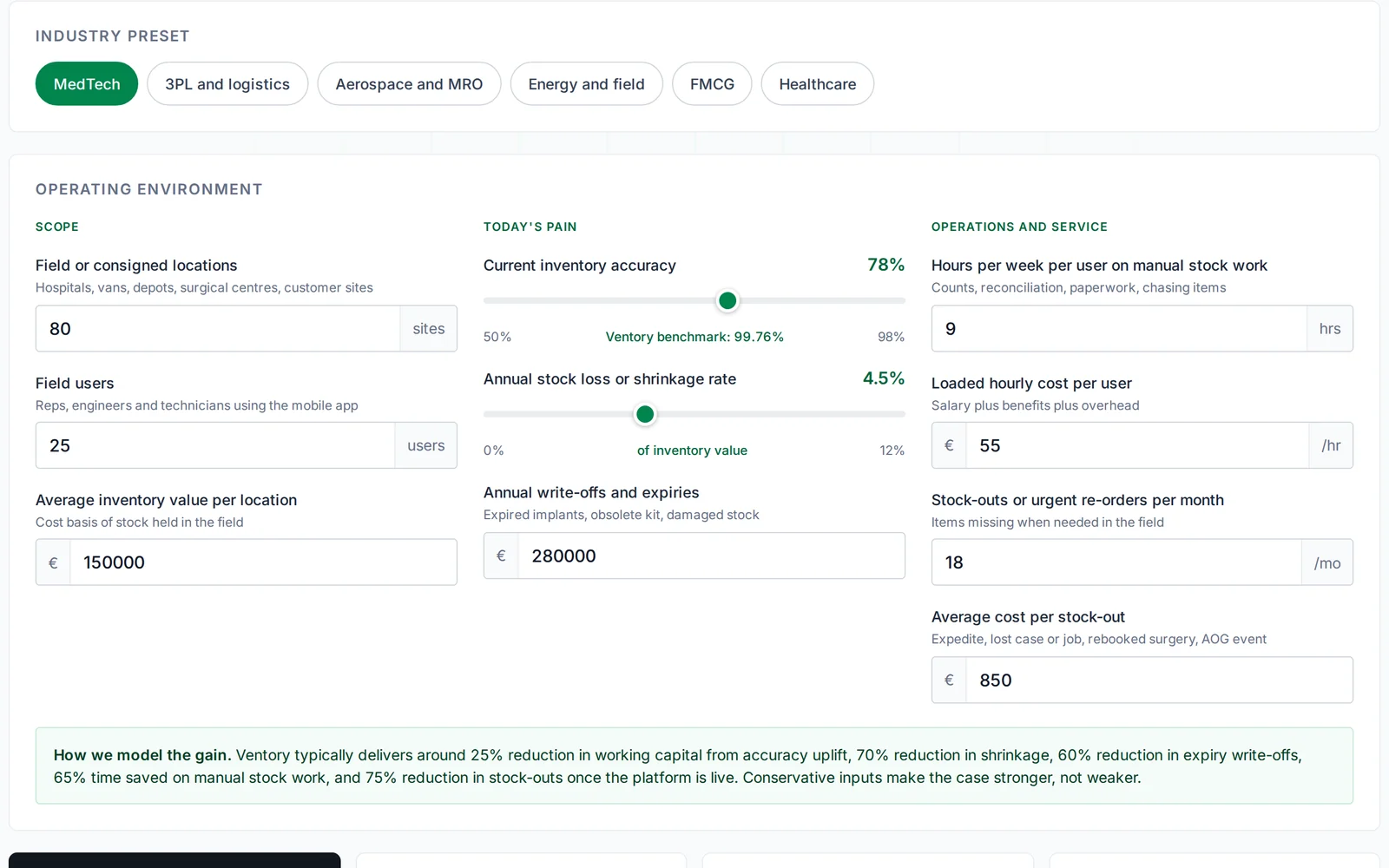
For a mid-sized field operation with 100 field personnel, the spreadsheet tax typically runs €1-€3M per year.
What modern trunk stock management looks like
Replacing spreadsheets with a proper field inventory layer should deliver five things:
1. Every trunk has a digital manifest - real-time view of what's in every van or rep case, by SKU, lot, expiry.
2. Consumption is captured at the point of use - not at the end of the week. Scan the barcode, confirm the customer/procedure, done. 10 seconds.
3. Replenishment is automated - min/max thresholds per trunk, automatic replenishment orders into the ERP, delivered to the rep's next stop.
4. Reconciliation is continuous - not a monthly fire drill. The ERP and the trunk are always in sync.
5. Mobile-first, offline-capable - works in a hospital basement, on a motorway, at a remote site with no signal.
The economics
We typically see trunk stock deployments deliver, within 6 months:
- 70%+ reduction in shrinkage
- 50%+ reduction in stock-outs at the point of use
- 20-30% reduction in trunk stock value held (same service level, less capital tied up)
- 3-5 hours per week returned to each field rep/engineer - often the biggest financial win
- Real-time compliance audit trail for UDI/controlled substances
The business case usually closes inside 9 months.
A template that already works
A national ambulance service runs exactly this model across 100 ambulances, and hits 99.76% stock accuracy. A global logistics provider uses Ventory to deliver trunk-stock-style field inventory to their own customers as a white-label service. A global medtech manufacturer manages consigned implant trunk stock across European hospitals on the same platform.
Different industries, same architecture, same results.
Getting started
If you're running trunk stock today on spreadsheets:
- Pick 5-10 reps or engineers as a pilot cohort
- Load their current stock into a field inventory layer
- Run for 6-8 weeks - measure shrinkage, stock-outs, admin time
- Scale
Deployments at this size take weeks. The hardest part is usually deciding to stop tolerating the spreadsheet tax.
Running trunk stock on Excel? Book 30 minutes → - we'll show you what your operation looks like without it.
Frequently asked questions
What is trunk stock?
Trunk stock is the inventory field teams carry with them - in sales rep trunks, engineer service vans, implant reps' travel cases and ambulance boots. It's the closest inventory to the point of use and often the most operationally critical stock in the business, because first-time-fix rates, surgical outcomes and emergency response all depend on it.
Why is trunk stock so hard to manage?
Because it moves constantly, is consumed without warning, is replenished under pressure, and is managed by people (reps, engineers, paramedics) whose job isn't logistics. Every traditional inventory system assumes a warehouse, a desk and time - none of which trunk stock has.
How much does poorly-managed trunk stock cost?
For a mid-size field operation with 100 field personnel, the spreadsheet tax typically runs €1-€3M per year: 5-15% shrinkage, expiry waste on lot-controlled goods, lost deals and failed first-time-fixes from stock-outs, and 3-5 hours of rep/engineer admin time per week.
What does modern trunk stock management look like?
Five characteristics: a digital manifest for every trunk, consumption captured at the point of use in under 10 seconds, automated min/max replenishment into the ERP, continuous reconciliation (not monthly), and mobile-first, offline-capable UX that works in hospital basements and on motorways.
What results can I expect?
Within six months: 70%+ shrinkage reduction, 50%+ fewer stock-outs at the point of use, 20-30% lower trunk stock value held, and 3-5 hours per week returned to each field rep or engineer - often the biggest financial win. Business case typically closes inside nine months.
About Ventory
Ventory is the field inventory layer for regulated, high-stakes industries. We give MedTech, 3PL, Aerospace, Energy and FMCG leaders real-time visibility and control over inventory outside the four walls - in hospitals, ambulances, trunk stock, consignment locations, and field service vans. Ventory is ERP-agnostic (SAP, Oracle, Dynamics, Sage, NetSuite) and trusted by a global medtech manufacturer, a national ambulance service, global logistics and consumer-goods operators. See how it works →
Ten questions. You get a field readiness score, a gap tier and the three fixes worth doing first.

Ventory is the field inventory layer between your ERP or WMS and the teams working outside the warehouse: engineer vans, forward stocking locations, consigned stock and loaner kits.
About Ventory