Consignment inventory is one of the most underestimated cost and compliance risks in medtech. Learn how real-time visibility turns it into a competitive advantage.
Your field rep just used a high-value surgical device in a procedure. It went perfectly. The surgeon is happy. The patient is doing well.
Now answer these questions: What was the lot number of the device used? Where is the replacement shipping from? Who legally owns the stock sitting in that hospital's storeroom right now?
If the answer to any of those questions involves a spreadsheet, a phone call, or an educated guess, you have a consignment inventory problem that's costing you more than you realise.
What consignment inventory is (and why it's so tricky)
Consignment inventory is stock that has been placed at a customer site, typically a hospital, but remains legally owned by the manufacturer or distributor until the moment of use.
Hospitals love it. It frees up their working capital, reduces procurement complexity, and means the right devices are on hand for procedures without tying up the hospital's own budget. It's a proven commercial model and, for many medtech companies, a prerequisite for winning and keeping NHS and hospital contracts.
But for the medtech company holding that inventory, consignment creates a unique set of risks that sit at the intersection of finance, compliance, and customer relationship management.
The financial exposure
Let's start with the money.
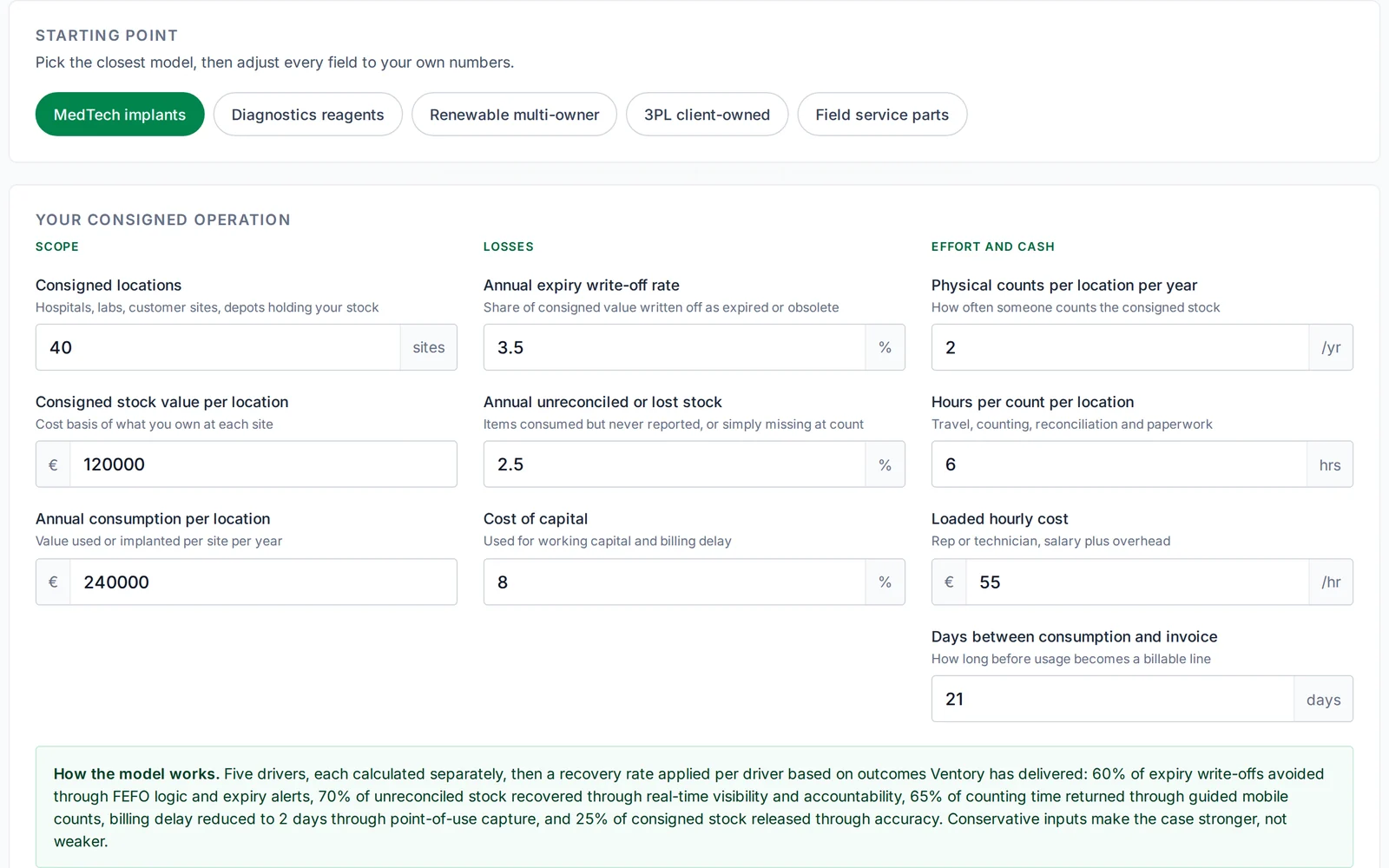
The total value of consignment stock held by a mid-sized medtech company across its field network is typically significant and poorly tracked. Research has found that medtech companies often plan production without full visibility into inventory they've already consigned to hospitals, leading to both overproduction and stockouts happening simultaneously.
- Expired stock write-offs - nobody tracked the expiry dates against actual usage rates at the consignment location
- Lost or misplaced devices - consumed or misappropriated without being invoiced back to the hospital
- Billing disputes - disagreements about what was used versus what was on site at the time
- Stock imbalance - overstocking at low-velocity sites while high-demand sites run short
These aren't edge cases. They're systemic and they compound at scale. A company with 200 field reps managing consignment stock across 400 hospital sites has a visibility problem that no spreadsheet can solve.
The compliance risk: EU MDR and EUDAMED
From 28 May 2026, EUDAMED becomes mandatory for medical device companies operating in the EU. Every device in the field, including devices on consignment at hospital sites, needs to be traceable to its UDI record.
That means lot numbers captured at point of use. It means knowing which registered device record corresponds to the item consumed in a procedure. It means audit trails that can withstand regulatory scrutiny.
If your consignment tracking process is manual, or relies on the rep remembering to fill in a form, your EUDAMED compliance is built on sand.
The customer satisfaction risk nobody talks about
Here's the angle that gets less attention than the financial and compliance exposure: consignment inventory failure is a customer relationship failure.
When a surgeon reaches for a device and it's not there, or it's expired, or the size needed is out of stock, the problem lands not on the supply chain manager but on the rep who owns that relationship. The trust built across months of consultative selling and clinical support can evaporate in a single theatre moment.
The inverse is also true. Medtech companies that get consignment right, with proactive replenishment, expiry alerts sent before they become incidents, and clean usage reporting, build a different kind of customer relationship. They become operationally embedded with the hospital, not just commercially connected.
What good consignment management looks like in 2026
The technology to solve consignment inventory management properly exists. The companies pulling ahead are using it.
- Real-time location tracking - knowing, at any moment, what is on site at each hospital. Not what was delivered three weeks ago minus what you think was used.
- Mobile-first point-of-use capture - the consumption event is recorded the moment it happens, by the rep on the ground, on a mobile device.
- Automated replenishment triggers - the right replacement stock is ordered the moment a device is consumed, not when someone notices the shelf is empty.
- Expiry management - proactive alerts when items are approaching their use-by date, so expired stock gets rotated out before it becomes a compliance issue.
- Clean audit trails - when a regulator, a customer, or an internal audit asks what was on site, when, and what happened to it, you can answer in seconds.
At Ventory.io, these capabilities are built into a single platform, ERP-agnostic, so it works whether your back-office runs on SAP, Oracle, Sage, or Microsoft Dynamics, and mobile-first, because the critical data capture happens in the field, not at a desk.
The competitive angle
This is where it gets interesting for medtech founders and commercial leaders.
Consignment inventory management is increasingly a procurement criterion for large hospital systems and NHS trusts. The ability to provide accurate usage data, clean replenishment processes, and regulatory-grade audit trails isn't just operationally useful, it's becoming a reason to win or lose contracts.
The medtech companies that have already digitised their consignment operations are using it in their commercial pitches. "We give you real-time visibility into what's on site, what's been used, and what's on its way" is a genuinely differentiating statement when your competitor's answer involves emailing spreadsheets.
The bottom line
Consignment inventory is not a niche operational problem. It's a financial risk, a compliance risk, a customer risk and, for companies that solve it well, a competitive opportunity.
The question isn't whether to digitise your consignment management. It's how quickly you can do it before the window to differentiate closes.
Ventory.io is a real-time field inventory management platform for medical device companies and healthcare providers. Trusted by organisations including the NHS London Ambulance Service. ERP-agnostic, mobile-first, and built for EU MDR compliance.
Ten questions. You get a field readiness score, a gap tier and the three fixes worth doing first.

Ventory is the field inventory layer between your ERP or WMS and the teams working outside the warehouse: engineer vans, forward stocking locations, consigned stock and loaner kits.
About Ventory