The SAP inventory management module runs the warehouse, but 20-40% of inventory lives in vans, on consignment and at customer sites where SAP cannot see it. Here is how a field inventory layer extends SAP and closes the gap in 4-8 weeks.
The SAP inventory management module stops at the warehouse door
The SAP inventory management module runs the stock backbone of thousands of enterprises. Materials Management, Inventory Management and Extended Warehouse Management track goods receipts, stock movements and valuations with the rigour SAP is known for. Inside the plant and the warehouse, it is hard to beat.
Then the stock leaves the building, and the same module goes quiet. The pallet shipped to a hospital, the parts loaded into an engineer van, the consigned implants on a customer shelf: SAP knows they left, but not what happens next. That blind spot is where the field inventory tax is paid.
What the SAP module does well
Give SAP a controlled location and it is excellent. It values stock, enforces process, posts movements to the general ledger, and gives finance a clean, auditable picture. For warehouse and plant inventory, the SAP inventory management module is the system of record, and it should stay that way.
The problem is not what SAP does. It is what the field asks of it.
Where it stops: the field
In field-heavy industries, 20-40% of finished-goods inventory sits outside the warehouse: on consignment, in loaner kits, in engineer vans, in ambulance boots, at customer sites. The SAP module was built for a fixed location with scanners, trained operators and connectivity. The field has none of those.
So the data breaks down in predictable ways:
- No real-time point of use. A part used at a customer site is logged later, on paper or from memory, if at all.
- A 12-click transaction. The SAP screen was built for a desk, not a nurse or an engineer with seconds to spare.
- No offline. Hospital basements and remote sites have no signal, so the capture never happens.
- Stale stock. The module shows a sealed, full quantity weeks after it was opened and half-used.
This is the same blind spot we describe in your ERP doesn't know what's outside the warehouse. The SAP module inherits it because it was never meant to solve it.
Why bolt-on field modules fail
The instinct is to extend SAP with a field module or a custom mobile build. Most stall. Integration complexity with legacy ERP systems blocks 58% of enterprises, and a custom field app typically takes a year to deploy, lands at 30-50% adoption, and breaks on the next upgrade. The field team goes back to the spreadsheet, and the SAP data drifts further from reality.
What a field inventory layer adds to SAP
The model that works does not replace the SAP inventory management module. It extends it. A field inventory layer sits between SAP and the field, captures what happens outside the four walls, and syncs it back so SAP stays the system of record. Four capabilities:
- Point-of-use capture. A scan records the item, lot and expiry in seconds, at the moment of consumption, by the person who touched it.
- Offline-first mobile. Field teams scan with no signal, and the data syncs when the connection returns.
- Automated replenishment triggered by real field consumption against min and max thresholds, pushed back into SAP.
- Two-way sync. Stock, movements and consumption flow back to SAP so finance and planning see one truth.
Ventory is ERP-agnostic, integrates with SAP and is listed on the SAP Store. It runs alongside the module you already have. See how the connection works on systems integrations.
The proof
Ventory keeps distributed stock accurate across 450+ field locations for enterprise customers in MedTech, 3PL, logistics and consumer goods, syncing back to the ERP of record. A national ambulance service holds 99.76% rolling stock accuracy across a fleet of 100 vehicles, with field adoption above 95%. Deployment runs 4-8 weeks, not the 12-18 months a custom SAP field module takes.
Getting started
- Map the inventory that leaves your SAP-managed warehouse: consignment, vans, loaner kits, customer sites.
- Quantify the leak: shrinkage, expiry write-offs, unbilled consumption, stockouts.
- Pilot a field inventory layer that syncs to SAP at 3-5 sites. Target 4-8 weeks.
- Measure accuracy and the time field teams spend on admin.
- Scale across sites, with SAP still the system of record.
Stock that disappears from SAP the moment it ships? Book a demo →
Related reading
Frequently asked questions
What is the SAP inventory management module?
It is the part of SAP that tracks stock: goods receipts, movements, valuations and counts, through Materials Management, Inventory Management and Extended Warehouse Management. It is built for plants and warehouses and acts as the financial system of record for inventory.
Can SAP track inventory outside the warehouse?
Not in real time at the point of use. SAP records what shipped, but it assumes a controlled location with scanners, trained operators and connectivity. Consigned stock, van stock and customer-site inventory are consumed without a real-time signal, so the SAP record drifts from reality.
Do I need to replace SAP to fix field visibility?
No. A field inventory layer extends SAP rather than replacing it. It captures field activity on a mobile, offline-first app and syncs stock and consumption back to SAP, which stays the system of record for finance and planning.
How does a field inventory layer integrate with SAP?
Through a two-way sync. Master data and stock flow from SAP to the field layer; consumption, counts and replenishment flow back. Ventory is ERP-agnostic, listed on the SAP Store, and connects to SAP, Oracle, Microsoft Dynamics, Sage and NetSuite.
About Ventory
Ventory is the field inventory layer for regulated, high-stakes industries. We give MedTech, 3PL, Aerospace, Energy and FMCG leaders real-time visibility and control over inventory outside the four walls, in hospitals, ambulances, trunk stock, consignment locations, and field service vans. Ventory is ERP-agnostic (SAP, Oracle, Dynamics, Sage, NetSuite) and trusted by a global medtech manufacturer, a national ambulance service, global logistics and consumer-goods operators. See how it works →
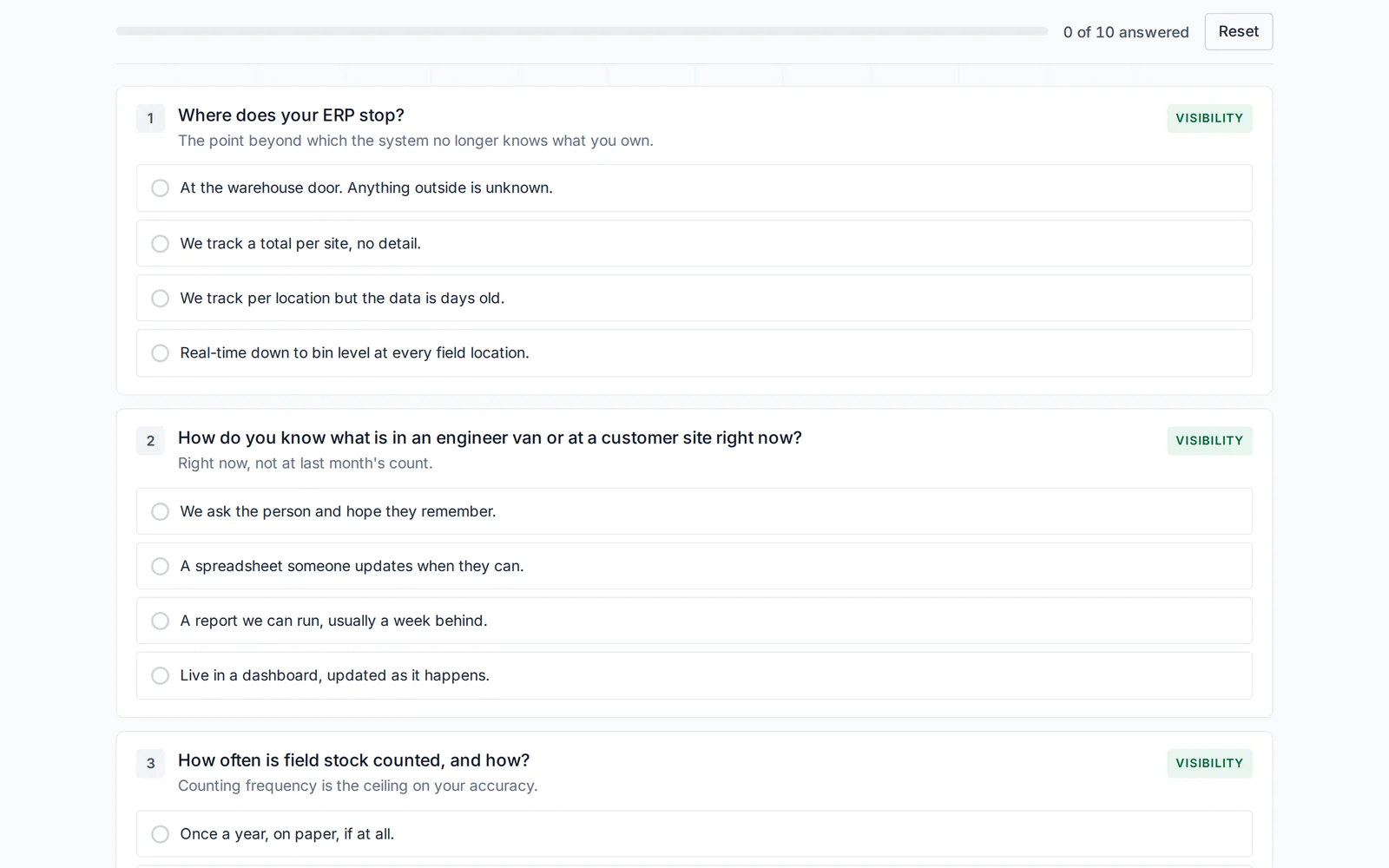
Ten questions. You get a field readiness score, a gap tier and the three fixes worth doing first.

Ventory is the field inventory layer between your ERP or WMS and the teams working outside the warehouse: engineer vans, forward stocking locations, consigned stock and loaner kits.
About Ventory