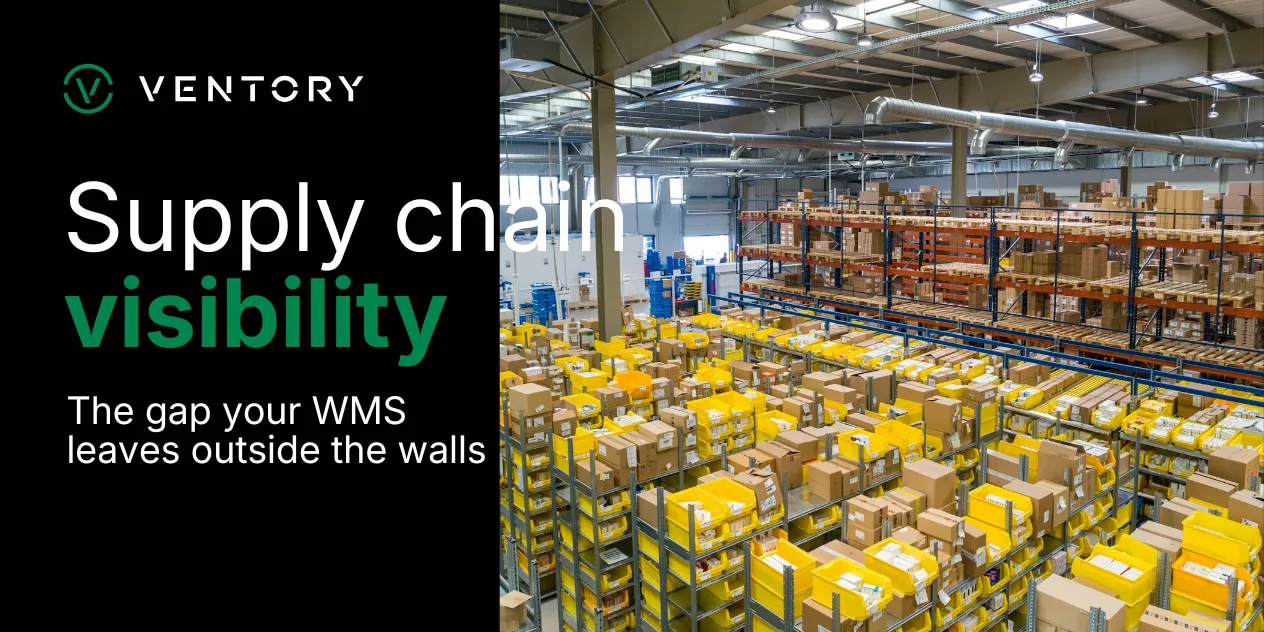
Your WMS sees inside the four walls. The 20-40% of inventory beyond them stays dark. Here's how 3PLs close the supply chain visibility gap and win contracts.
Visibility stops at the dock door
Ask a 3PL where its inventory is and the answer is precise, right up to the dock door. Inside the warehouse, the WMS knows every pallet, bin and lot. Beyond it, the picture fades fast.
That is a problem, because more and more of the value a 3PL manages lives beyond the warehouse: consigned stock at a customer's hospital, spare parts in an engineer van, promotional stock at a retail site, kit staged at a project location. The WMS was never built to see any of it.
Supply chain visibility that ends at the dock door is not visibility. It is a blind spot with a dashboard.
Why the gap matters now
The 3PL market is growing fast, from $1.8 trillion in 2026 toward $4.3 trillion by 2035. The growth is not in basic warehousing. It is in higher-touch services: value-added warehousing and distribution is the fastest-growing 3PL service type. Customers want a partner that can manage inventory end to end, including the stock that leaves the warehouse.
Visibility is the lever. Leading operations cut stockouts by around 15% through better inventory visibility alone. The 3PL that can see the field wins the contract. The one that cannot watches that work go to a specialist.
What the WMS cannot do
The WMS is excellent at what it was built for: dense, fixed, scanner-rich warehouse operations. It struggles the moment stock moves into the field:
- It assumes a fixed location. Field stock moves.
- It assumes trained operators and scanners. The field has a rep, a nurse or an engineer.
- It assumes connectivity. The field has basements, remote sites and dead zones.
Forcing a WMS to track field inventory is like forcing a spreadsheet to do CRM. You can make it limp along. It will not give you visibility you can trust. We explain the same architecture point in your ERP doesn't know what's outside the warehouse.
Closing the gap with a field inventory layer
The fix is a field inventory layer that extends visibility beyond the four walls and feeds it back to the WMS and ERP. Five capabilities:
- A live manifest for every field location, by SKU, lot, serial and owner.
- Scan-based capture at the point of use, in seconds, on the device the field person already carries.
- Real-time, multi-client visibility so a 3PL can show each customer exactly what is where.
- Automated replenishment triggered by real field consumption.
- Two-way integration with the WMS and ERP, so the field layer extends the stack instead of replacing it. See systems integrations.
The WMS stays the system of record inside the walls. The field layer covers everything beyond them. One source of truth, end to end.
The proof
Ventory runs field inventory across 450+ locations for enterprise customers in MedTech, 3PL, logistics and consumer goods, with stock accuracy above 99% and field adoption above 95%. A national ambulance service holds 99.76% accuracy across a fleet of 100 vehicles restocked by crews between calls. The same architecture gives a 3PL real-time visibility into client stock wherever it sits. Deployment runs 4-8 weeks. For the vertical view, see Ventory for 3PL.
Getting started
If you run a 3PL with stock beyond the warehouse:
- Map the share of client inventory value that lives outside the four walls today.
- Quantify what the blind spot costs: stockouts, shrinkage, disputed counts, lost upsell.
- Pilot a field inventory layer with one client or service line. Target 4-8 weeks.
- Measure visibility, accuracy and client retention.
- Scale across the book.
Selling visibility that stops at the dock door? Book a demo →
Frequently asked questions
What is supply chain visibility software?
Supply chain visibility software tracks the location and status of goods across the supply chain. Most of it is strongest inside the warehouse and weakest beyond it. True end-to-end visibility includes the 20-40% of inventory that sits outside the four walls, in vans, at customer sites and on consignment.
Why isn't a WMS enough for supply chain visibility?
A WMS is built for fixed, scanner-rich warehouse operations. It assumes a fixed location, trained operators and connectivity, none of which the field offers. So it loses sight of stock the moment it leaves the dock door, which is exactly where a growing share of 3PL value now sits.
How does field inventory visibility help a 3PL win contracts?
Customers increasingly want a partner that manages inventory end to end, including field stock. Better visibility cuts stockouts by around 15% and lets a 3PL show each client exactly what is where. That capability is a differentiator in tenders and a driver of value-added revenue.
Does a field inventory layer replace my WMS?
No. It extends it. The WMS stays the system of record inside the warehouse; the field layer covers everything beyond it and syncs both ways. Together they give one source of truth from the warehouse to the point of use.
How long does it take to deploy?
Typically 4-8 weeks for a pilot with one client or service line and 3-6 months to scale across the book, connecting to your existing WMS and ERP.
About Ventory
Ventory is the field inventory layer for regulated, high-stakes industries. We give MedTech, 3PL, Aerospace, Energy and FMCG leaders real-time visibility and control over inventory outside the four walls, in hospitals, ambulances, trunk stock, consignment locations, and field service vans. Ventory is ERP-agnostic (SAP, Oracle, Dynamics, Sage, NetSuite) and trusted by a global medtech manufacturer, a national ambulance service, and global logistics and consumer-goods operators. See how it works →
Ten questions. You get a field readiness score, a gap tier and the three fixes worth doing first.

Ventory is the field inventory layer between your ERP or WMS and the teams working outside the warehouse: engineer vans, forward stocking locations, consigned stock and loaner kits.
About Ventory