
Vendor managed inventory cuts stock 20-35%, but most VMI programmes go blind the moment stock leaves the warehouse. Here's how to close the field gap in 4-8 weeks.
VMI works on paper. It breaks in the field.
Vendor managed inventory is a simple promise. The supplier, not the customer, decides when to replenish. The customer gets stock on hand without managing it. The supplier gets preferred-vendor status and a direct line into demand.
The promise holds right up to the moment stock leaves the warehouse. After that, most VMI programmes run blind.
The supplier sets replenishment based on what the customer reports, or what a rep eyeballed on a site visit three weeks ago. The data is stale before it lands. And the whole model depends on knowing what was actually used, where, and when. That is exactly the data most VMI programmes do not have. Ventory is a field inventory platform built for exactly this: it gives suppliers real-time visibility and control of VMI stock at customer sites, so replenishment runs on what was actually used.
What the gap costs
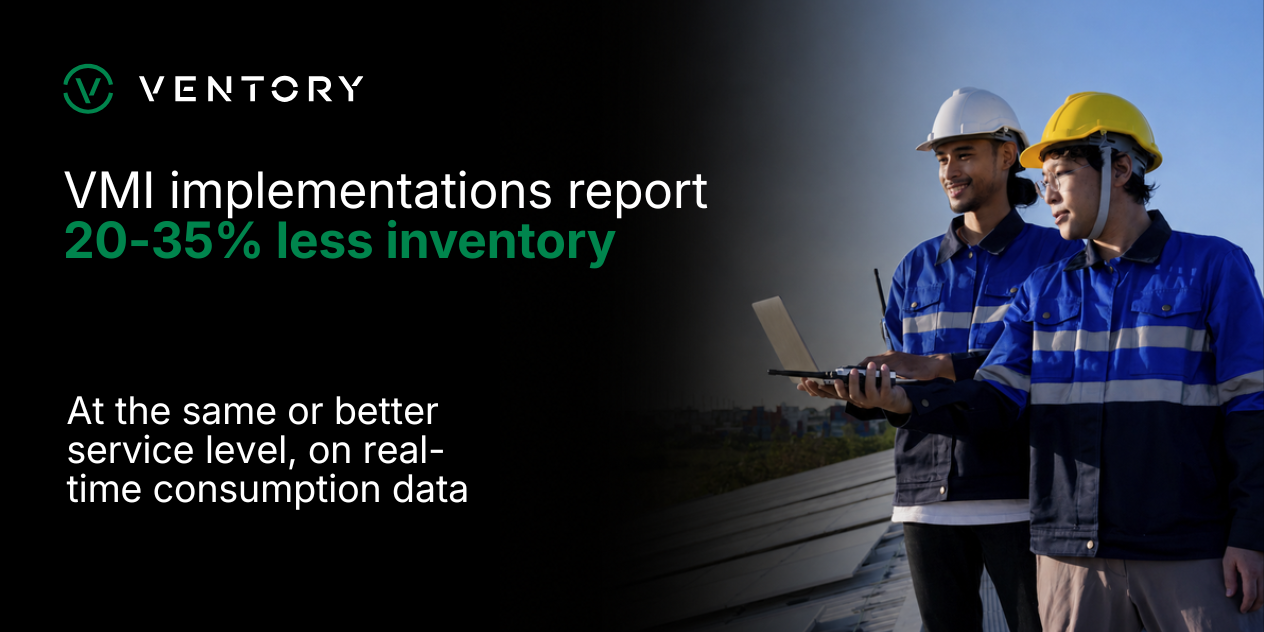
When VMI runs on real-time data, the numbers are strong. Combined vendor-managed and consignment models have cut total supply chain cost by close to 15% in published research. Most VMI implementations report 20-35% inventory reductions at the same or better service level.
When VMI runs on stale data, the same model leaks money:
- Overstock at low-velocity sites. Replenishment fires on estimates, not consumption. Capital sits still.
- Stockouts at high-velocity sites. The signal arrives too late. The customer runs dry on the SKU that matters most.
- Unbilled consumption. In consignment-style VMI, 3-8% of used goods never generate an invoice line. Pure margin gone.
- Rep time. Hours per week counting shelves and emailing restock requests instead of selling.
The model that should reduce working capital ends up tying it up at one site while starving another.
VMI is not consignment. The difference matters.
The two get used interchangeably. They are not the same.
In VMI, the supplier manages replenishment, but the customer usually owns the stock on delivery. In consignment, the supplier retains ownership until the stock is used. Many enterprise programmes combine both: vendor-owned, vendor-managed, customer-located.
The combination is commercially powerful and operationally brutal. It needs ownership tracking, usage capture and billing triggers that warehouse systems were never built to provide. For the consignment side of that equation, see our 2026 guide to consignment inventory management and how consigned stocks are tracked in the field.
Why ERPs cannot run VMI in the field
VMI lives at customer sites: hospital storerooms, retail back rooms, service depots, distributor shelves. Your ERP was built for your warehouse.
Three reasons it fails here:
- It is transactional, not event-driven. The ERP wants reconciled batches. VMI needs a real-time stream of what got used.
- The UX is built for a desk. The person consuming VMI stock is a nurse, a technician, a store manager. Not a logistics professional with time for a 12-click transaction.
- It cannot see the customer site. The ERP knows what you shipped. It has no real-time view of what is physically on the shelf at the customer.
ERP "field modules" exist. Most stall at 30-50% adoption and break on the next upgrade. We explain why in your ERP doesn’t know what’s outside the warehouse.
What modern VMI runs on
The architecture that works is a field inventory layer sitting between the ERP and the customer site. Five capabilities:
- A digital manifest for every customer location: what should be there, by SKU, lot and expiry.
- Scan-to-use capture at the point of consumption. 10 seconds, not a back-office reconciliation.
- Automated replenishment triggered by actual usage against min and max thresholds, pushed into the ERP.
- Usage-based billing so consumption raises an invoice line automatically.
- Real-time visibility for the supplier across every site, so replenishment is a decision made on data, not on a rep’s memory.
The ERP stays the system of record. The field layer captures everything that happens outside the warehouse and syncs it back. One source of truth, no rip-and-replace.
The proof
Ventory runs this model across 450+ field locations for enterprise customers in MedTech, 3PL, logistics and consumer goods. A national ambulance service holds 99.76% stock accuracy across a fleet of 100 vehicles, restocked by crews between call-outs. Field adoption sits above 95%, higher than most office applications, because the workflow is faster than the paper it replaces. Deployment runs 4-8 weeks, not the 12-18 months of an ERP field module.
Getting started
If you run a VMI programme above roughly 20 sites:
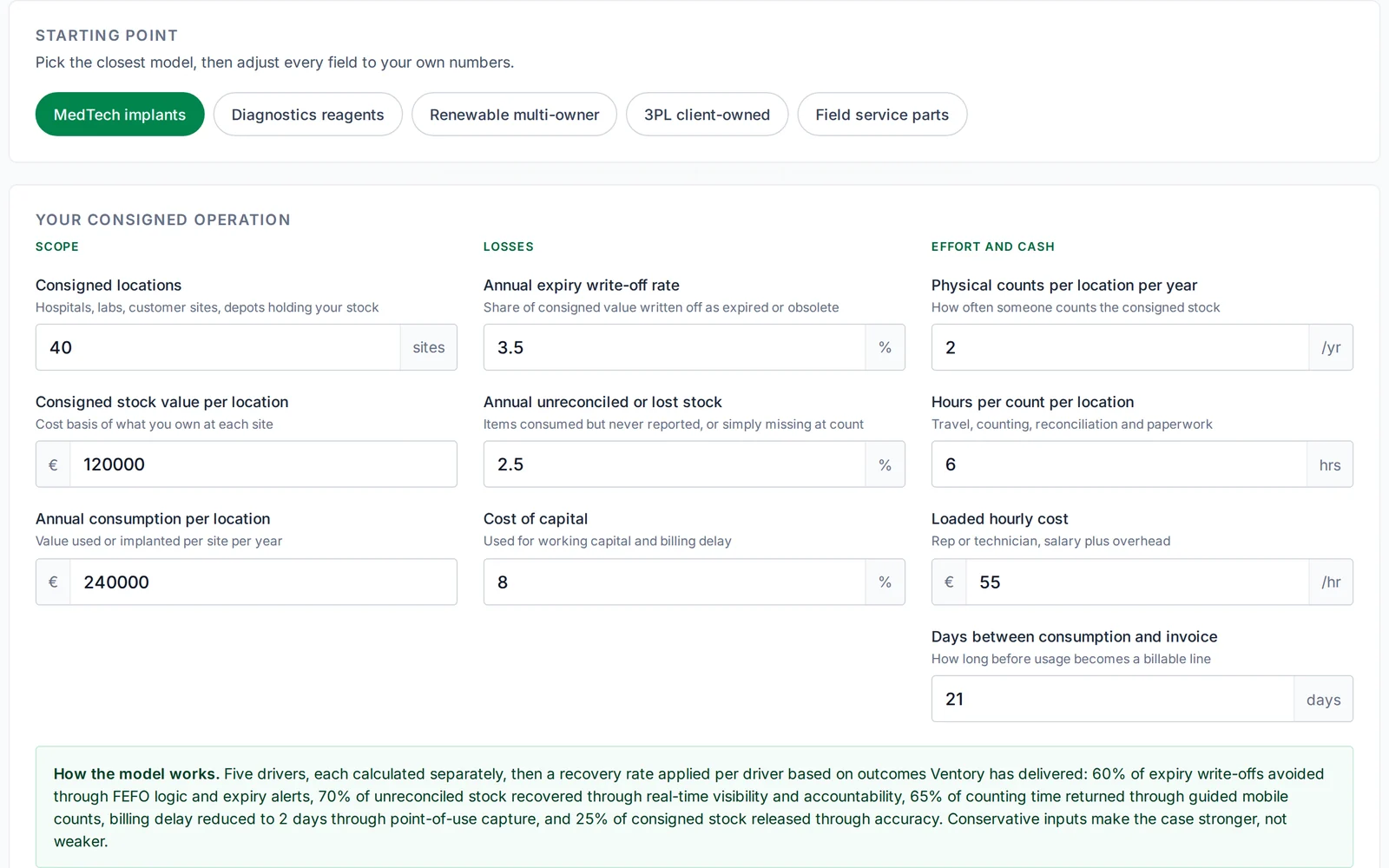
- Quantify the leak: overstock, stockouts, unbilled consumption, rep admin time.
- Pick one customer segment or vertical where the pain is sharpest.
- Deploy a field inventory layer at 3-5 sites. Target 4-8 weeks.
- Measure inventory reduction, service level and billing accuracy.
- Scale across the programme.
This is not a transformation programme. It is a weeks-long deployment that usually pays back inside a year.
Running VMI on spreadsheets and site visits? Book a demo →
Inside a VMI system: the terms explained
Search around VMI and you meet a cluster of overlapping terms: system, software, supply chain, program, agreement. They are layers of the same model, and it helps to keep them apart.
Here is how they fit together, in the language of this playbook:
- VMI system / vendor managed inventory software: the software layer that captures consumption at the customer site and triggers replenishment against min and max thresholds, syncing back to the ERP as system of record.
- VMI in the supply chain: where the model sits, between supplier and customer, with the supplier managing replenishment for stock held at the customer’s location.
- VMI program: the commercial arrangement between one supplier and one customer, covering sites, SKUs, thresholds and who owns the stock.
- VMI agreement: the contract behind the program, fixing ownership, service levels, billing triggers and liability.
Frequently asked questions
What is vendor managed inventory (VMI)?
Vendor managed inventory is a model where the supplier, not the customer, manages replenishment for stock held at the customer’s location. The supplier monitors consumption and restocks against agreed thresholds. Done with real-time data, VMI typically cuts inventory 20-35% while holding or improving service levels.
What is the difference between VMI and consignment inventory?
VMI is about who manages replenishment: the supplier does. Consignment is about who owns the stock: the supplier does, until it is consumed. Many enterprise programmes combine both, leaving stock that is vendor-owned, vendor-managed and customer-located, which needs real-time usage and ownership tracking to run cleanly.
Why do VMI programmes fail?
Most fail on data. Once stock leaves the warehouse, the supplier loses real-time visibility and replenishes on stale counts or rep estimates. The result is overstock at some sites, stockouts at others, unbilled consumption and heavy manual admin. The model that should reduce working capital ends up trapping it.
Do I need to replace my ERP to run modern VMI?
No. A field inventory layer connects to SAP, Oracle, Microsoft Dynamics, Sage and NetSuite as the system of record. It captures consumption and replenishment at the customer site and syncs back to the ERP. The ERP stays your single source of truth for finance and fulfilment.
How long does a field VMI deployment take?
Typically 4-8 weeks for a pilot at 3-5 sites and 3-6 months to scale across a programme or region, compared with 12-18 months for an ERP field module. The business case usually pays back inside a year.
What is a VMI system?
A VMI system is the combination of process and software a supplier uses to run vendor managed inventory at customer locations. In practice that means a digital manifest per site, scan-to-use capture at the point of consumption, and automated replenishment triggered by actual usage against min and max thresholds. The ERP stays the system of record; the VMI system feeds it real-time data from the field.
What does VMI software do?
VMI software captures what gets used at each customer site, compares stock on hand against agreed thresholds, and triggers replenishment into the ERP automatically. In consignment-style programmes it also raises an invoice line when stock is consumed, closing the 3-8% unbilled consumption gap. The best VMI software works in seconds on a phone, because the person using it is a nurse, a technician or a store manager, not a logistics professional.
Go deeper
This playbook is the hub. These guides take each part of the model further:
- How to set up a VMI program: the step-by-step setup, from agreement and thresholds to first automated replenishment.
- Best consignment inventory software and VMI tools: how the software options compare for vendor-owned stock in the field.
- Consignment inventory management guide: the ownership side of the model, from usage capture to billing triggers.
- Multi location inventory management: keeping stock accuracy when one programme spans dozens or hundreds of sites.
About Ventory
Ventory is the field inventory layer for regulated, high-stakes industries. We give MedTech, 3PL, Aerospace, Energy and FMCG leaders real-time visibility and control over inventory outside the four walls, in hospitals, ambulances, trunk stock, consignment locations, and field service vans. Ventory is ERP-agnostic (SAP, Oracle, Dynamics, Sage, NetSuite) and trusted by a global medtech manufacturer, a national ambulance service, and global logistics and consumer-goods operators. See how it works →
Ten questions. You get a field readiness score, a gap tier and the three fixes worth doing first.

Ventory is the field inventory layer between your ERP or WMS and the teams working outside the warehouse: engineer vans, forward stocking locations, consigned stock and loaner kits.
About Ventory