Inventory visibility software means three different things: transit platforms, WMS and the field inventory layer. Learn what each one tracks, what it cannot see, and how to pick the right one for stock at rest in vans, forward stocking locations and consigned sites.
Inventory visibility: the definition buyers need before the demos start
Inventory visibility is knowing what stock you hold, where it sits, and in what condition, in a record you can trust right now. Not last quarter's count. Not the ERP's best guess. The actual quantity at the actual location, current enough to act on. The definition is simple. Buying inventory visibility software is not, because the moment you search the term, three unrelated product categories answer the call. Each one watches a different kind of stock. Only one of them watches the stock that is most likely invisible in your operation today: inventory at rest outside the warehouse.
We have covered the neighbouring questions already. For the full map of the category across the whole chain, from factory gate to consignment shelf, read our guide to supply chain visibility software. For the business case and the cost of running blind, read real-time inventory visibility. This post is narrower and more practical: it is the buying guide for the third kind of visibility, stock at rest across distributed locations. Ventory builds that third kind, so we will be explicit about what the other two categories do better, and where each one stops.
Why the mix-up costs real money
Vendors share one label. Buyers inherit the confusion. An operations director types "inventory visibility software" and gets shipment trackers, warehouse suites and multi-location stock platforms side by side, priced from four figures to seven. Pick the wrong category and you get flawless data on stock you could already see, while the inventory in engineer vans, forward stocking locations and consigned cabinets keeps drifting from the system of record.
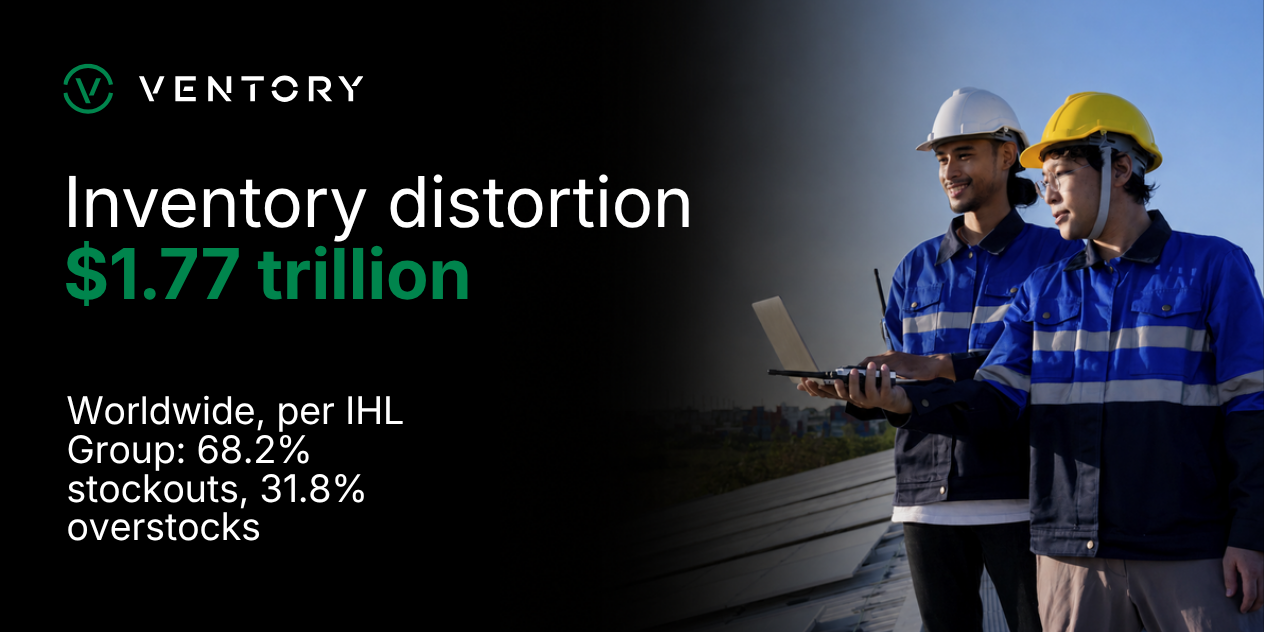
The drift is expensive. Per IHL Group, inventory distortion costs businesses $1.77 trillion worldwide: 68.2% of it from stockouts, 31.8% from overstocks. Both failure modes are visibility failures. You stock out because no system saw the van run empty. You overstock because no system trusted the count, so every planner padded it.
The warehouse is rarely the source of that distortion. A warehouse running a modern WMS holds accuracy in the high nineties. The field does not. Vans, technician trunk stock, consignment locations and customer sites typically run on spreadsheets, WhatsApp photos and memory. That is where the write-offs, the emergency shipments and the audit findings come from. At Ventory we call this the field inventory gap, and it is the stretch of the chain the first two software categories were never designed to see.
The three kinds of visibility software
Here is the category split that the shared label hides.
1. Transit visibility platforms track shipments while they move between locations. Think project44, FourKites and Shippeo. They ingest carrier data, GPS and telematics, and tell you where the truck, container or parcel is and when it will arrive. Excellent at ETAs and exception alerts. But the record ends at the proof of delivery. Once the pallet is signed for, the platform's job is done. It cannot tell you what is on the shelf a week later, or whether the technician who received the parts ever logged them.
2. Warehouse management systems give you visibility inside a building you control. Manhattan Associates, Blue Yonder, SAP EWM and Körber run receiving, putaway, picking and packing with bin-level precision. Within the four walls, a good WMS is the right answer. Outside them, it has nothing to say. A WMS does not model an engineer's van, a consignment cabinet in a hospital, or a forward stocking location shared with a 3PL. Extending one to cover those locations is a customisation project most teams abandon.
3. The field inventory layer covers the third stretch: stock at rest across distributed locations. Vans, forward stocking locations, consigned and customer sites, loaner kits, technician trunk stock. It gives every field location a live, scannable record and syncs it with the ERP, so planners see one truth across hundreds of small stock points. This is the category Ventory operates in, and it is the one neither of the first two can substitute for, because their data models stop at the dock door or the delivery scan.
| Category | What it tracks | Typical vendors | What it cannot see |
|---|---|---|---|
| Transit visibility platforms | Shipments moving between locations: trucks, containers, parcels, ETAs and in-transit exceptions | project44, FourKites, Shippeo | Stock at rest. The record ends at the proof of delivery. |
| Warehouse management systems (WMS) | Stock inside a building you control: receiving, putaway, picking and packing at bin level | Manhattan Associates, Blue Yonder, SAP EWM, Körber | Anything outside the four walls: vans, forward stocking locations, consigned and customer sites |
| Field inventory layer | Stock at rest across distributed locations: vans, forward stocking locations, consigned and customer sites, synced two-way with the ERP | Ventory | Shipments in motion and in-warehouse operations; it connects to the systems that watch those |
The three categories are complements, not competitors. A medtech manufacturer may need all three: Shippeo watching the shipment, a WMS running the distribution centre, and a field inventory layer holding the record once stock lands in the rep's car or the hospital's consignment cabinet. The buying mistake is assuming any one of them covers the other two stretches.
What to demand from the third kind
If your blind spot is stock at rest outside the warehouse, here is the checklist. Each item exists because a generic tool fails on it.
- Location-level records for every stock point. Every van, cabinet and forward stocking location is its own countable location with its own history. If the tool models "the field" as one bucket, walk away. For the operating model behind this, see our guide to multi-location inventory management.
- Scanning built for non-logistics users. Field engineers and sales reps are not warehouse operators. Transactions must take seconds on a phone, with barcode scanning that reads damaged and multi-code labels. Adoption is the whole game: a system the field skips is a spreadsheet with a licence fee.
- Offline capture. Hospital basements, rooftops and rural substations have no signal. The app must record transactions offline and sync when coverage returns, or your most remote stock stays your least accurate.
- Consignment logic. Stock you own on someone else's premises needs usage capture, ownership status and replenishment triggers in one flow. This is a distinct discipline; see consigned stock management.
- ERP-agnostic, two-way sync. The layer must feed SAP, Oracle, Dynamics, Sage or NetSuite without a rip-and-replace. The ERP stays the system of record for value; the field layer becomes the system of record for location truth.
- Counting that fits a working day. Cycle counts per location in minutes, not annual shutdowns. Accuracy is maintained by frequency, not heroics.
- Weeks to live, not quarters. A field visibility rollout should not resemble a WMS programme. Deployment runs 4-8 weeks. Anything slower usually means you are buying category two software for a category three problem.
The proof
The third category is not theoretical. A national ambulance service runs Ventory across a 100-vehicle fleet and holds 99.76% rolling stock accuracy on the medical consumables inside those vehicles, locations that no WMS could model and no transit platform could see after delivery. A global medtech manufacturer uses the same layer across 450+ field locations, with field adoption above 95%. Across deployments, teams report 70% fewer stockouts and 35% less excess stock once every at-rest location has a live record, with +30% productivity in the field teams doing the counting.
Getting started
- List every place stock sits at rest outside the warehouse. Vans, forward stocking locations, consigned sites, loaner kits, customer premises. The count is usually 3-10x what leadership expects.
- Classify your blind spot. If shipments go missing in motion, you need category one. If the warehouse is chaotic, category two. If stock vanishes after delivery, category three.
- Pick one metric to move. Stock accuracy at field locations, stockout rate, or write-offs. Baseline it now, however rough the number.
- Start a focused first scope at 3-5 locations. One region, one product family, real users. Deployment runs 4-8 weeks, including ERP connection.
- Scale on evidence. When accuracy at the first locations crosses 99%, extend the same model to the rest of the network.
Seeing the gap in your own network? Talk to the Ventory team.
Field notes
- One label, three products: transit platforms, WMS and the field inventory layer each watch a different stretch, and buying the wrong one leaves 100% of your blind spot intact.
- Inventory distortion costs $1.77 trillion worldwide per IHL Group, and both halves of it, stockouts and overstocks, are visibility failures.
- A 100-vehicle ambulance fleet holds 99.76% stock accuracy because every van is a countable location, not a line in a spreadsheet.
Frequently asked questions
What is inventory visibility?
Inventory visibility is the ability to see what stock you hold, where it is, and in what condition, in a record current enough to act on. True visibility covers every location where stock sits, including vans, forward stocking locations and consigned sites, not just the warehouse. If your system can only answer for stock inside the four walls, you have warehouse visibility, not inventory visibility.
What software provides inventory visibility across multiple locations?
A field inventory layer such as Ventory: software that gives every distributed location its own live, scannable stock record and syncs all of them with the ERP. A WMS covers one building and transit platforms cover goods in motion, so neither provides at-rest visibility across many small locations. Look for mobile scanning, offline capture, consignment logic and two-way ERP sync.
What is the difference between supply chain visibility and inventory visibility?
Supply chain visibility is the wider discipline: seeing goods across the whole chain, including shipments in motion, supplier status and warehouse operations. Inventory visibility is the subset concerned with stock you hold, at rest, at known locations. You can have strong supply chain visibility from a transit platform and still have no idea what sits in your engineer vans, because those tools stop tracking at the proof of delivery.
Do transit visibility platforms like project44 or FourKites track inventory at rest?
No. They are built to track shipments moving between locations, using carrier and telematics data, and their record ends when the shipment is delivered. They are excellent at ETAs and in-transit exceptions. For stock sitting in vans, cabinets or forward stocking locations after delivery, you need a field inventory layer.
Is a WMS enough for inventory visibility?
Only if all your stock lives inside warehouses you operate. A WMS delivers bin-level accuracy within the four walls but does not model vans, consignment locations or customer sites. Companies with field stock typically pair the WMS with a field inventory layer, each covering its own stretch and both syncing to the ERP.
How fast can inventory visibility software go live?
A field inventory layer deploys in 4-8 weeks, including ERP integration, because it adds a layer rather than replacing core systems. Start a focused first scope at 3-5 locations, prove accuracy above 99%, then scale across the network.
About Ventory
Ventory is the field inventory layer for regulated, high-stakes industries. We give MedTech, 3PL, Aerospace, Energy and FMCG leaders real-time visibility and control over inventory outside the four walls, in hospitals, ambulances, trunk stock, consignment locations, and field service vans. Ventory is ERP-agnostic (SAP, Oracle, Dynamics, Sage, NetSuite) and trusted by a global medtech manufacturer, a national ambulance service, global logistics and consumer-goods operators. See how it works →
Ten questions. You get a field readiness score, a gap tier and the three fixes worth doing first.

Ventory is the field inventory layer between your ERP or WMS and the teams working outside the warehouse: engineer vans, forward stocking locations, consigned stock and loaner kits.
About Ventory