4PL inventory visibility usually stops at the warehouse. 3PLs report 99% stock accuracy inside it and 63% at field locations. See where stock goes dark across every 3PL and how a 4PL can close the gap.
A client calls its 4PL with one question: where is our stock? The control tower can answer for the truck, the container and the pallet in the warehouse. Then the stock moves to a hospital, a wind farm, an engineer's van or a customer's consignment cabinet. The screen goes quiet. The client still expects an answer.
That gap is the subject of this post. We look at what 4PL inventory visibility covers today, where it stops, what the gap costs shippers, and how a 4PL can close it across every 3PL it manages. For how Ventory works with 4PLs, see our 4PL page.
4PLs own the outcome, not the assets
The term 4PL goes back to 1996, when Accenture (then Andersen Consulting) described an integrator that assembles the resources and technology of other providers to run a complete supply chain. Gartner analysts put it in one line: if the 3PL is the logistics muscle, the 4PL is the logistics brain.
The model has gone mainstream. In December 2025 Gartner published its first Magic Quadrant for 4PL. A Gartner survey quoted at the launch found that 42% of nearly 220 supply chain leaders already outsource to a 4PL, and a further 35% plan to within two years.
That growth brings a harder job. A 4PL is accountable for a network it does not own. Some global shippers work with up to 25 different 3PL relationships, according to Gartner research cited by SupplyChainBrain. The 4PL sits above all of them and is expected to see everything.
What a control tower sees, and where it stops
Control towers are built around flows. Orders, bookings, shipments, carrier performance, on-time delivery. Warehouse stock comes in through each 3PL's WMS feed. The big 4PLs run several regional control towers and plug in dozens of technology partners to make that work.
The weak spot sits one step further. Once stock leaves the warehouse, it lands at locations no WMS was designed for:
- Consigned stock at hospitals and customer sites, still on the shipper's balance sheet.
- Forward stocking locations close to the customer, often run by a different 3PL than the main DC.
- Engineer vans and technicians carrying spare parts for field service.
- Site stock at wind farms, substations and project sites.
- Depot and base stock for defence and public sector clients.
In our view, this is where most control towers stop. They see the delivery. They do not see what happens to the stock after it lands. McKinsey's 2024 supply chain risk survey points in the same direction: 60% of leaders now have comprehensive visibility of tier-one suppliers, while visibility of deeper tiers fell for the second year running.
The numbers behind the blind spot
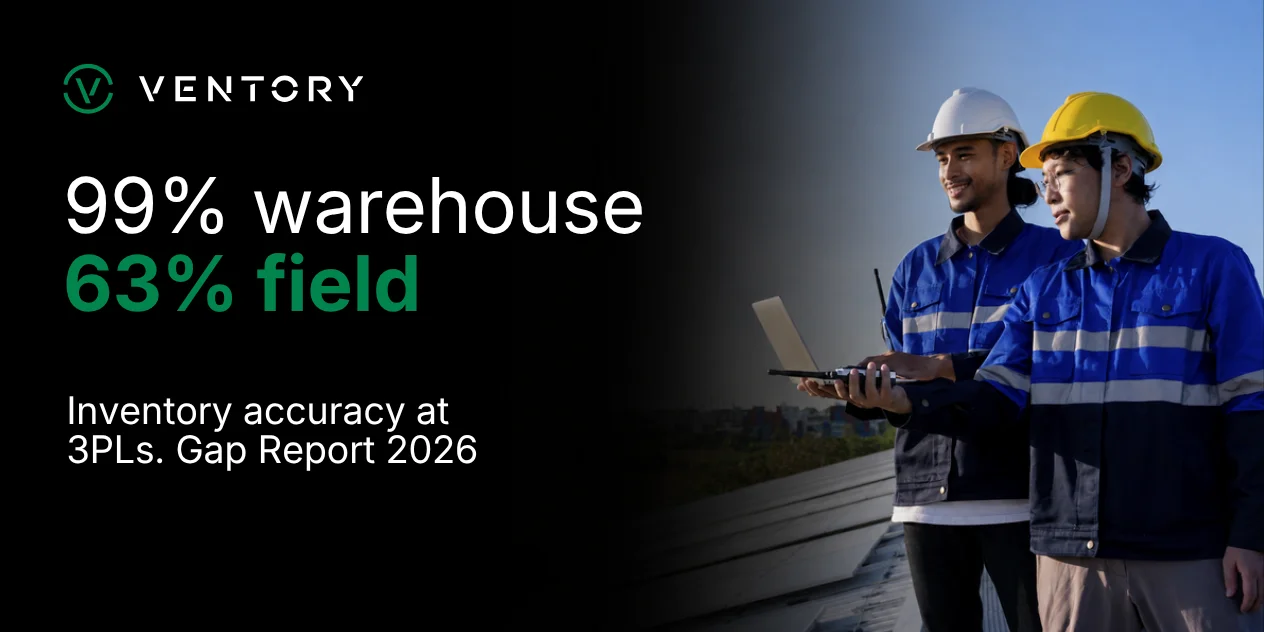
In 2026 we surveyed 312 professionals at third-party logistics providers for the 3PL Field Inventory Digitization Gap Report. The headline finding is a single gap: inventory accuracy of 99% in the warehouse, and 63% at field stock locations. Same companies. Same products. Different place.
The rest of the report explains why:
- 71% rely only on phone, email and spreadsheets to track field stock.
- Only 14% run a dedicated field inventory platform.
- 73% sent emergency freight in the past year because nobody knew where stock was.
- 62% had an SLA breach caused by a field stock error.
Now multiply that by the number of 3PLs in one client's network. Each provider tracks field stock its own way, on its own schedule. The 4PL gets a different spreadsheet from each one, if it gets one at all. The client pays for the emergency freight. The question lands on the 4PL.
Why the gap is hard to close from inside one 3PL
A single 3PL can digitise its own field stock. That helps, but it does not give the shipper one view. Four things keep the gap open:
- Different systems per 3PL. Each provider runs its own WMS and its own field process. None of them sees the others.
- No owner for the whole picture. The 3PL owns its sites. The shipper owns the stock. Nobody owns the view across all of them, except the 4PL.
- No signal at the edge. Hospital basements, rural sites and turbines rarely have a reliable connection. Paper fills the gap.
- ERP is the record, not the eyes. The shipper's ERP knows what was shipped. It does not know what was used, moved or returned in the field.
What 4PL inventory visibility should look like
The answer is not another control tower module. It is a field inventory layer: one live stock record for every location outside the warehouse, fed by the people who move the stock, and synced to the ERP the client already runs. We explain the model in Your ERP doesn't know what's outside the warehouse.
For a 4PL, that layer needs five things:
- One platform across every 3PL. Each provider in a client's network scans into the same system. One live stock number per location, whoever runs it.
- Capture at the point of use. Every receipt, transfer, consumption and count is scanned by the person doing it, with lot, serial and expiry where it matters.
- Works offline. The mobile app keeps working without a signal and syncs when the connection returns. See working offline.
- ERP-agnostic. Connect the client's ERP once: SAP, Oracle, Dynamics, Sage or NetSuite. No change to any 3PL's WMS.
- Fast to deploy. Live in 4-8 weeks for a focused scope. No rip and replace.
Proof: three 3PLs, one shipper, one platform
This set-up already runs. Three different 3PLs now work on Ventory for the same global consumer-goods company. Around 50,000 pallets have been processed since March.
We got there from the 3PL side, one provider at a time. A 4PL could offer the same set-up to every client it runs, from day one.
Across deployments, Ventory customers report 99.76% rolling stock accuracy, +70% fewer stockouts, +35% less excess stock and +30% productivity. For more on how 3PLs use Ventory, see our 3PL page.
Getting started: a 90-day plan for 4PLs
- Pick one client. Choose a client with stock outside the warehouse: medtech consignment, field service parts, energy site stock or defence depots.
- Map every location. List each site, van and cabinet that holds the client's stock, and which 3PL runs it.
- Connect the ERP once. Let movements flow back automatically, so the client's record matches the shelf.
- Scan at the point of use. Give every 3PL and field team the same mobile app for the scoped site group.
- Report accuracy per site and per 3PL. Bring the numbers to the next business review. Then scale.
Field notes
- 99% in the warehouse and 63% in the field is one gap, not two.
- A shipper with five 3PLs has five versions of the truth outside the warehouse.
- The 4PL is the only party in the network positioned to own one view across all of them.
Close the blind spot
Our guide The Control Tower Blind Spot covers the gap in more depth, with a self-check for 4PL teams. Or bring one client scenario to a 30-minute call. Book a partner call and we will show you one stock view across every 3PL in that network.
Frequently asked questions
What is 4PL inventory visibility?
It is the ability of a fourth-party logistics provider to see its clients' stock across every 3PL and location it manages. That includes warehouse stock and, increasingly, stock beyond the warehouse: consigned stock, forward stocking locations, engineer vans and site stock.
How is a 4PL different from a 3PL?
A 3PL runs specific logistics functions, such as warehousing and transport, often with its own assets. A 4PL designs and orchestrates the wider network, including several 3PLs, and acts as a single point of accountability for the shipper.
Why do control towers miss field inventory?
Control towers are built around orders, shipments and warehouse feeds. Stock at customer sites, in vans or with technicians sits outside every WMS, and is often tracked on spreadsheets. Without a field inventory layer, that data never reaches the tower.
Do the 3PLs need to replace their WMS?
No. Each 3PL keeps its own WMS. A field inventory layer covers the locations the WMS was never designed for, and syncs with the shipper's ERP.
How fast can a 4PL go live with a client?
A focused scope (one client, one site group, one ERP connection) goes live in 4-8 weeks. The route is a discovery call, a demo on the client's scenario, then the deployment.
About Ventory
Ventory is the field inventory layer for regulated, high-stakes industries. We give MedTech, 3PL, Aerospace, Energy and FMCG leaders real-time visibility and control over inventory outside the four walls, in hospitals, ambulances, trunk stock, consignment locations, and field service vans. Ventory is ERP-agnostic (SAP, Oracle, Dynamics, Sage, NetSuite) and trusted by a national ambulance service, a global 3PL and a global consumer-goods company. See how it works →
Ten questions. You get a field readiness score, a gap tier and the three fixes worth doing first.

Ventory is the field inventory layer between your ERP or WMS and the teams working outside the warehouse: engineer vans, forward stocking locations, consigned stock and loaner kits.
About Ventory