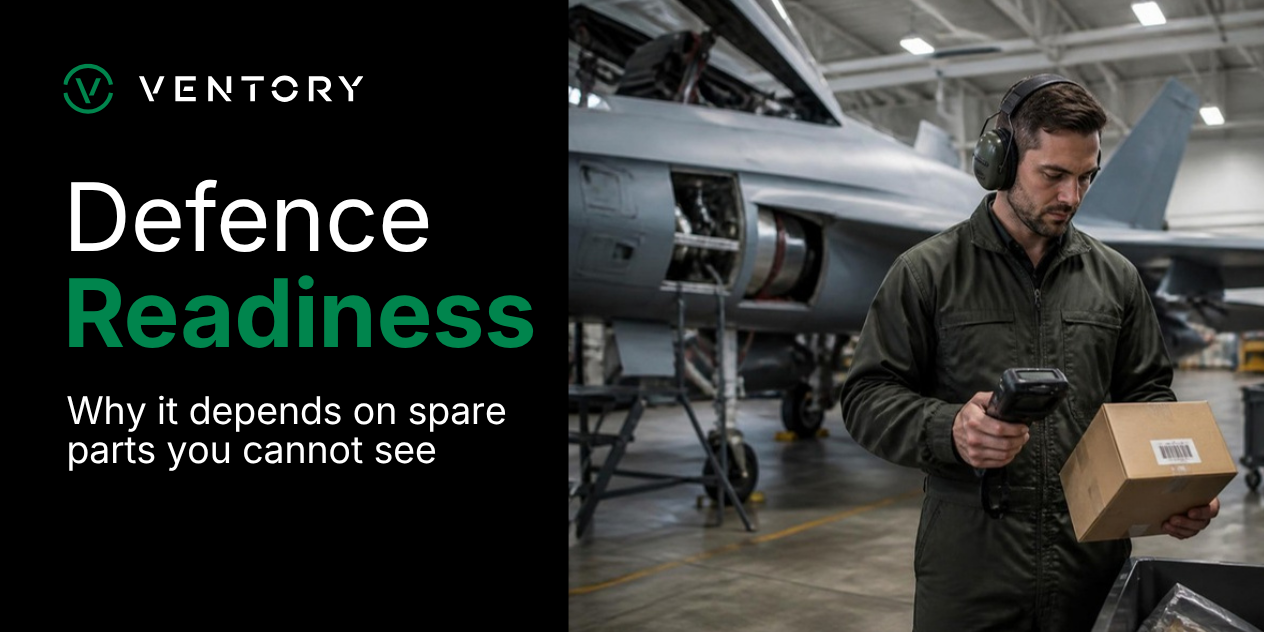
Defence inventory management decides readiness. The US GAO found 25 of 27 Army and Air Force aircraft missed their mission capable goal in FY2024. See why spare parts drop out of sight and how to track every depot, base and vehicle.
Picture a squadron grounded for one part. The part exists. It sits in a workshop two bases away, booked on a spreadsheet nobody opened this week. That is the real test of defence inventory management: not how much stock you own, but whether you can find the right part in time.
Budgets are rising fast. Equipment fleets are growing. The spare parts that keep them ready are spread across more depots, bases, vehicles and forward sites than ever. This post covers why that stock drops out of sight, what it costs in readiness, and how to get it back in view without replacing the systems you already run. For the full picture of how Ventory supports defence teams, see our defence inventory management page.
Defence inventory management is now a readiness question
At the 2025 summit in The Hague, NATO Allies committed to invest 5% of GDP a year in defence and security by 2035. At least 3.5% goes to core defence. Up to 1.5% goes to broader security and resilience.
The money is already moving. According to the NATO Secretary General's Annual Report 2025, every Ally spent more than 2% of GDP on defence in 2025, for the first time. European Allies and Canada invested $574 billion, up 20% in real terms on 2024.
More spending buys more platforms. More platforms need more spare parts, held in more places. Every new aircraft, vehicle and vessel adds line items that have to be in the right place when a mechanic opens a panel. Readiness is no longer only a procurement question. It is an inventory question.
What it costs when parts go missing
The clearest public data comes from auditors. Their numbers are consistent, and they are not small.
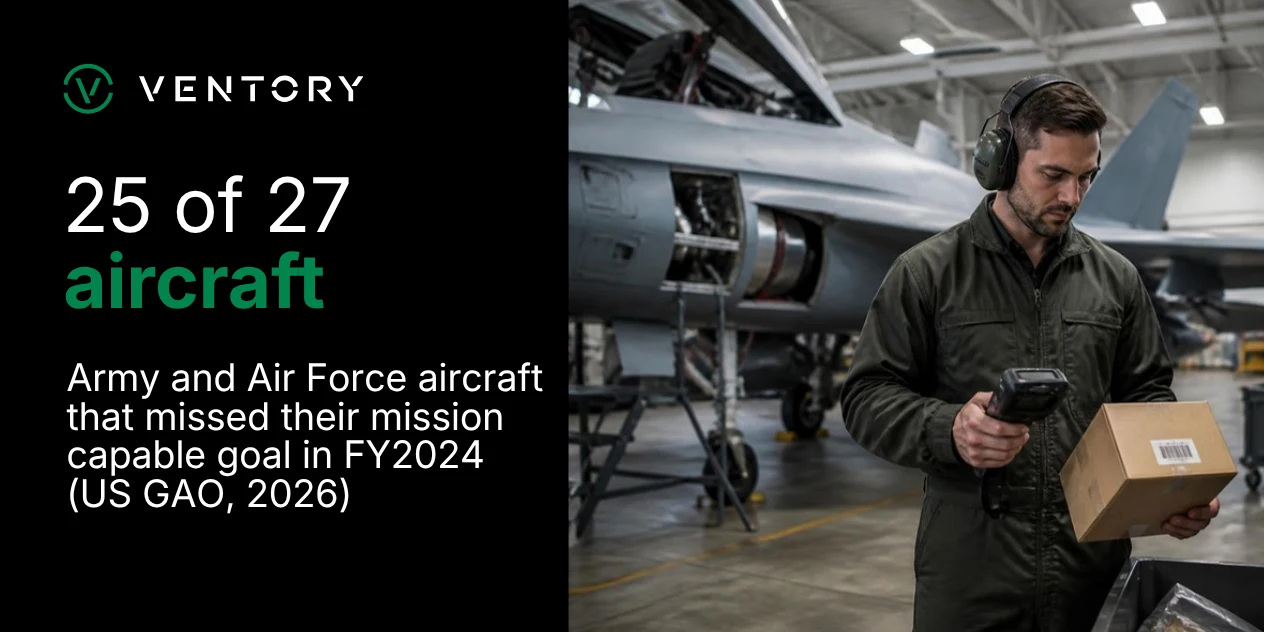
- 25 of 27 aircraft missed their goal. The US Government Accountability Office (GAO) reported in March 2026 that the Army and the Air Force did not meet their mission capable rate goals in fiscal year 2024 for 25 of 27 aircraft.
- All 18 ground vehicles reviewed have parts problems. The same report found that all 18 ground vehicles it looked at face challenges related to a lack of parts and materiel and access to technical data.
- 4 of 49 over a decade. An earlier GAO review found that only 4 of 49 aircraft types met their annual mission capable goal in most years from 2011 to 2021. Officials cited problems getting parts and supplies among the causes.
- Over $85 million in lost parts. On the F-35, GAO found that since May 2018 one prime contractor incurred losses of over 1 million spare parts totalling over $85 million, and that the Department of Defense did not fully account for its global pool of F-35 spare parts.
Europe faces the same pattern. The UK National Audit Office found that the Ministry of Defence manages an £11.8 billion inventory, and that two of its core inventory systems are nearly 40 years old. Old systems were built for central stores. They were never built to follow a part onto a vehicle or into a deployed unit.
Why military stock drops out of sight
Nobody plans to lose track of a part. It happens one hand-over at a time.
- Stock leaves the depot and the record stays behind. The central system knows what shipped. It rarely knows what was used, moved or put back at the base, the workshop or the vehicle.
- Every level keeps its own records. Depot, base, workshop, unit and contractor each hold part of the truth, on their own schedule and often in their own format.
- No signal, no update. Training areas, remote bases, ships and deployed units cannot count on a connection. Paper fills the gap, and somebody keys it in later, if at all.
- Accountability is personal, but the data is not. Equipment is signed out to a named person. When the signature lives on paper, the audit trail ends at the filing cabinet.
- Distrust drives hoarding. When nobody trusts the numbers, units hold extra stock just in case. Capital sits in parts that are duplicated, misplaced or no longer needed.
At a glance: where defence stock sits and what tracks it
What good defence inventory management looks like
The answer is not another central system. It is a field inventory layer: one live record for every location outside the depot, fed at the moment stock moves, and synced back to the ERP you already run. We explain the model in Your ERP doesn't know what's outside the warehouse.
For defence, that layer has to meet a stricter bar:
- A live position for every part. Depot, base, workshop, vehicle and forward site, in one view.
- Capture at the point of use. Every issue, transfer, return and count is scanned by the person doing it, with serial and lot where it matters.
- Works without a signal. The mobile app keeps working offline and syncs when the connection returns.
- Accountability built in. User roles per stock location, signed hand-overs for equipment, and a full audit trail of every scan, move and count.
- Security your accreditors recognise. ISO 27001 certification, SOC 2 compliance and GDPR compliance, plus one-time code login.
- Alerts before a shortage. Minimum levels per location trigger a restock before a missing part grounds a platform.
- No rip and replace. The ERP stays the financial system of record. The field layer sits next to it.
There is one more requirement that matters in defence: proof. A dual-use platform that already runs field inventory in medtech, energy, field services and logistics brings a track record that a bespoke build cannot.
Proof from the field
Ventory customers report 99.76% rolling stock accuracy, +70% fewer stockouts, +35% less excess stock and +30% productivity. Teams go live in 4-8 weeks alongside their existing ERP, and field adoption runs at 95%+, because scanning is easier than paper or spreadsheets.
The same approach that keeps parts visible in engineer vans and hospital consignment closets works for vehicles, workshops and forward sites. The problem is the same: stock that leaves the central store and drops out of sight. See how it applies to defence on our defence industry page.
Getting started: five moves in 90 days
- Map every place that holds parts. Depots, bases, workshops, vehicles, deployed sites and contractor stores. Give each one an owner.
- Rank locations by readiness impact. Start where one missing part grounds a platform, not where the most stock sits.
- Scan at the point of use. Put issues, returns and counts on a mobile app at the pilot sites. Retire the paper form, not the people.
- Connect to the ERP. Let movements flow back automatically, so the central record matches the shelf.
- Measure accuracy per location. A strong depot figure can hide a weak workshop. Track each tier on its own and scale from the pilot.
Field notes
- 25 of 27 US Army and Air Force aircraft missed their mission capable goal in fiscal year 2024.
- A part that is booked but cannot be found is the same as a part you do not have.
- The fastest readiness gain is often already on the shelf, one base away.
See every part, at every site
Bring one question to a 30-minute call: where is your most critical spare part right now? Book a demo and we will show you how to answer it for every depot, base and vehicle.
Frequently asked questions
What is defence inventory management?
It is the control of spare parts, equipment and consumables across every location that supports military readiness: central depots, bases, workshops, vehicles, units and deployed sites. Good defence inventory management shows where each part is, who holds it and what will run out, in time to act.
Why do spare parts shortages hurt military readiness?
Aircraft, vehicles and ships cannot operate without the right part. The US GAO has linked problems getting parts and supplies to missed mission capable goals across aircraft fleets, and found that all 18 ground vehicles it reviewed face challenges related to a lack of parts and materiel.
Do we need to replace our ERP or legacy inventory system?
No. A field inventory layer sits next to the ERP. It captures movements at bases, workshops and vehicles and syncs them back, so the ERP stays the system of record and the central view finally matches reality.
Can inventory software work at sites without a network connection?
Yes, if it is built for it. The Ventory mobile app works fully offline on iOS and Android, keeps scanning and counting without a signal, and syncs automatically when the connection returns.
How is security handled?
Ventory is ISO 27001 certified, SOC 2 compliant and GDPR compliant. Admins can require a one-time login code, user roles control what each person can see and change, and every movement is logged by user and time.
About Ventory
Ventory is the field inventory layer for regulated, high-stakes industries. We give MedTech, 3PL, Aerospace, Energy and FMCG leaders real-time visibility and control over inventory outside the four walls, in hospitals, ambulances, trunk stock, consignment locations, and field service vans. Ventory is ERP-agnostic (SAP, Oracle, Dynamics, Sage, NetSuite) and trusted by a national ambulance service, a global 3PL and a global consumer-goods company. See how it works →
Ten questions. You get a field readiness score, a gap tier and the three fixes worth doing first.

Ventory is the field inventory layer between your ERP or WMS and the teams working outside the warehouse: engineer vans, forward stocking locations, consigned stock and loaner kits.
About Ventory