Supply chain visibility beyond tier 1 stops short at both ends: sub-tier suppliers and the stock in vans, at customer sites and in consignment. See what the invisible tiers cost and five moves to close the gap.
Ask a supply chain team who supplies them and you get a clean answer. Ask who supplies their suppliers and the answer gets vague. Ask where their own spare parts are today and it goes quiet. That is the problem with supply chain visibility beyond tier 1: most programmes stop at the first answer.
Five years of resilience work made tier one visible. The rest of the chain is still dark, at both ends. This post maps the two invisible halves, puts a number on what they cost and shows how to close the gap without replacing your ERP.
Supply chain visibility beyond tier 1: where the map ends
The numbers are consistent. In McKinsey's 2025 supply chain risk pulse, 95% of companies see risk at their tier-one suppliers. For tier two and beyond, it is 42%. And 58% have mapped their tier-two suppliers, yet fewer than half of those have regular, direct contact with them. A map shows where a supplier is. It does not show what is happening there.
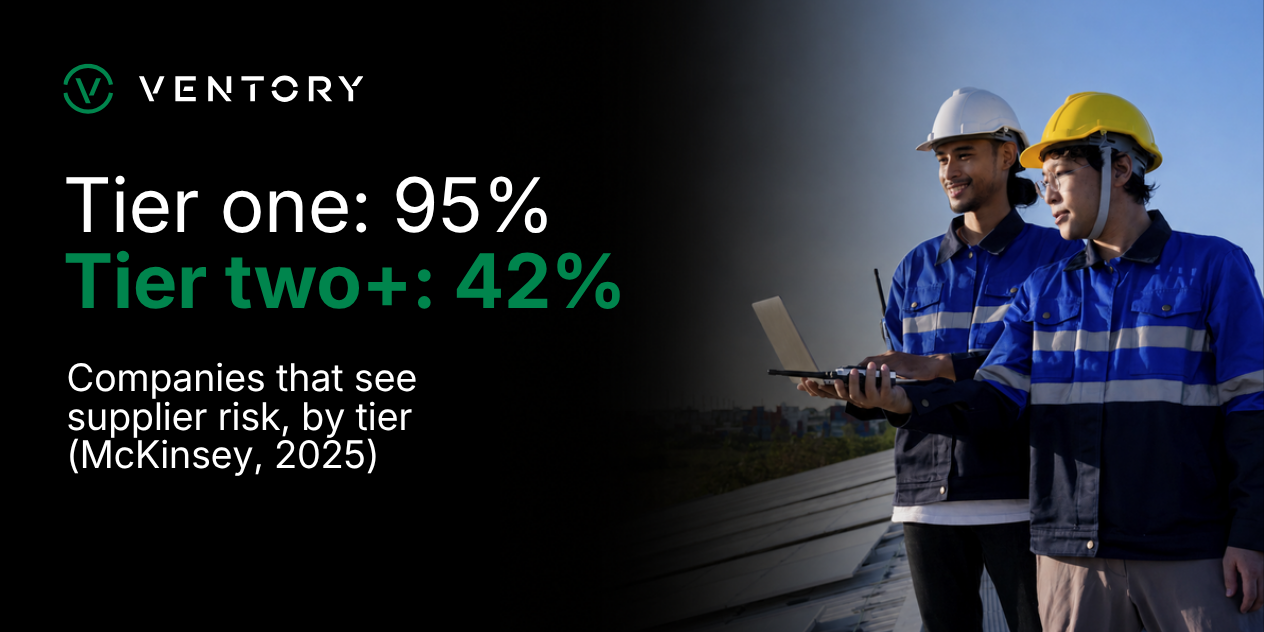
The trend does not fix itself. In McKinsey's 2024 survey, tier-one visibility rose ten points for the second year running, while good visibility into deeper tiers fell seven points. Effort goes where it is easiest.
A fresh data point confirms it. EFESO's global supply chain survey, published on 17 September 2026 with 250 senior executives in Europe and the US, found that only 31% of organisations report full visibility across their supply networks.
The other invisible tier starts at your loading dock
Most visibility work looks upstream, at suppliers. The second blind spot runs the other way. Once stock leaves your warehouse it splits into hundreds of small locations: forward stocking locations, engineer vans, customer sites, hospital consignment closets, project sites and partner warehouses.
Logistics teams call these tier 3 locations. The ERP sees very little of them. A van is one bin. A consignment closet is one line on a customer account. A project site is a delivery note. The goods are still yours, on your balance sheet and behind your service promise. You just cannot see them. We covered why in detail in Your ERP doesn't know what's outside the warehouse.
At a glance: the tiers and who sees them
| Tier | Where it sits | What usually tracks it |
|---|---|---|
| Tier 2 and 3 suppliers | Components and raw material, upstream | Supplier maps and risk tools, often a one-off mapping exercise |
| Tier 1 suppliers | Direct suppliers | Procurement systems, supplier portals, risk monitoring |
| Your warehouse | Central and regional stock | ERP and WMS |
| Tier 3 locations | Vans, customer sites, consignment, project sites | Calls, texts and spreadsheets, unless a field inventory layer is in place |
Why it matters: what the invisible tiers cost
Upstream, the cost is disruption. McKinsey estimates that companies can now expect disruptions lasting a month or longer every 3.7 years, with expected losses of almost 45% of one year's profits over a decade.
Downstream, the cost is quieter but constant. Ventory's 3PL Field Inventory Digitization Gap Report (312 respondents, fielded October 2025 to January 2026) found:
- 63% average field inventory accuracy across 3PLs, against 99% in the warehouse.
- 71% rely solely on phone, email and spreadsheets for field stock.
- 73% sent emergency freight in the past year because of a field stock visibility failure. Not because the stock did not exist, but because nobody knew where it was.
- $1.2M to $2.8M estimated annual cost for an operator with 100+ field stock locations.
MedTech shows the same pattern. In Ventory's MedTech Inventory Visibility Gap Report, one in three field teams had a case delay or cancellation tied to inventory in the past 90 days, and only 22% were very or completely confident their data was accurate.
Root causes: why visibility decays at every tier
Nobody decides to lose sight of their stock. It happens one handover at a time.
- Ownership and custody split. In consignment you own the stock and the customer holds it. In 3PL the customer owns the parts and you hold them.
- Every tier adds a party and a system. Distributor, carrier, 3PL, subcontractor. Each keeps its own records on its own schedule.
- The ERP sees a location, not a shelf. A fleet of 200 vans becomes 200 bins with no scan history and no owner.
- No signal, no data. Hospital basements, wind farms and rural sites. If a tool needs a connection, the data arrives late or never.
- Counting is nobody's job. Field teams are measured on cases, installs and uptime, not on inventory admin.
Where the invisible tier hurts most
The gap looks different in every industry. The question it raises is always the same: where is the part right now?
- MedTech. Consigned implants, loaner kits and trunk stock. Visibility decides whether a case goes ahead and whether usage gets billed. See how Ventory handles consigned stocks.
- 3PL and logistics. Customer-owned spares at forward stocking locations. You hold the stock, the SLA and the penalty. In the 3PL report, 62% had an SLA breach caused by a field stock error.
- Field services and energy. Engineer vans, project sites and remote assets. A wind turbine or solar inverter waits on one part, and that part often sits in another van, one region over.
- Defence and critical infrastructure. Readiness depends on spare parts at dispersed and forward sites. A resilience plan that stops at tier-one suppliers cannot answer the first question in a crisis.
What the right solution looks like
The fix is the same in both directions: one system of record for every tier that matters, fed at the moment stock moves, and connected back to the systems you already run.
Upstream, that means mapping critical tier-two suppliers and agreeing regular data sharing with them, not a one-off survey. Downstream, it means a field inventory layer between the ERP and the field. Stock at every van, site and consignment account gets a live position. Movements are captured by scan with serial, lot and expiry, even offline. The ERP stays the financial truth, and nobody rekeys data.
This is the layer most visibility software never reaches. We compared the three layers in Supply chain visibility software: the three layers and where each one stops.
Proof from the field
Ventory customers report 99.76% rolling stock accuracy, +30% productivity, +35% excess stock reduction and +70% fewer stockouts, and go live in 4-8 weeks on top of their existing ERP.
A field services contractor running 250+ stock locations moved from Excel to Ventory, reached 95%+ inventory accuracy with 130 active users, eliminated payment collection delays and grew 1.8x in two years.
Getting started: five moves beyond tier one
- Map every place that holds your stock. Not just every supplier. Give each location an owner.
- Rank tiers by what a stockout costs. A delayed surgery, a breached SLA and an offline turbine are not equal.
- Give every critical tier a system of record. Zero critical locations run by call, text or spreadsheet.
- Capture data where stock moves. Scan at the van, the site and the point of use.
- Measure accuracy per tier, not in total. A 99% warehouse can hide a 63% field.
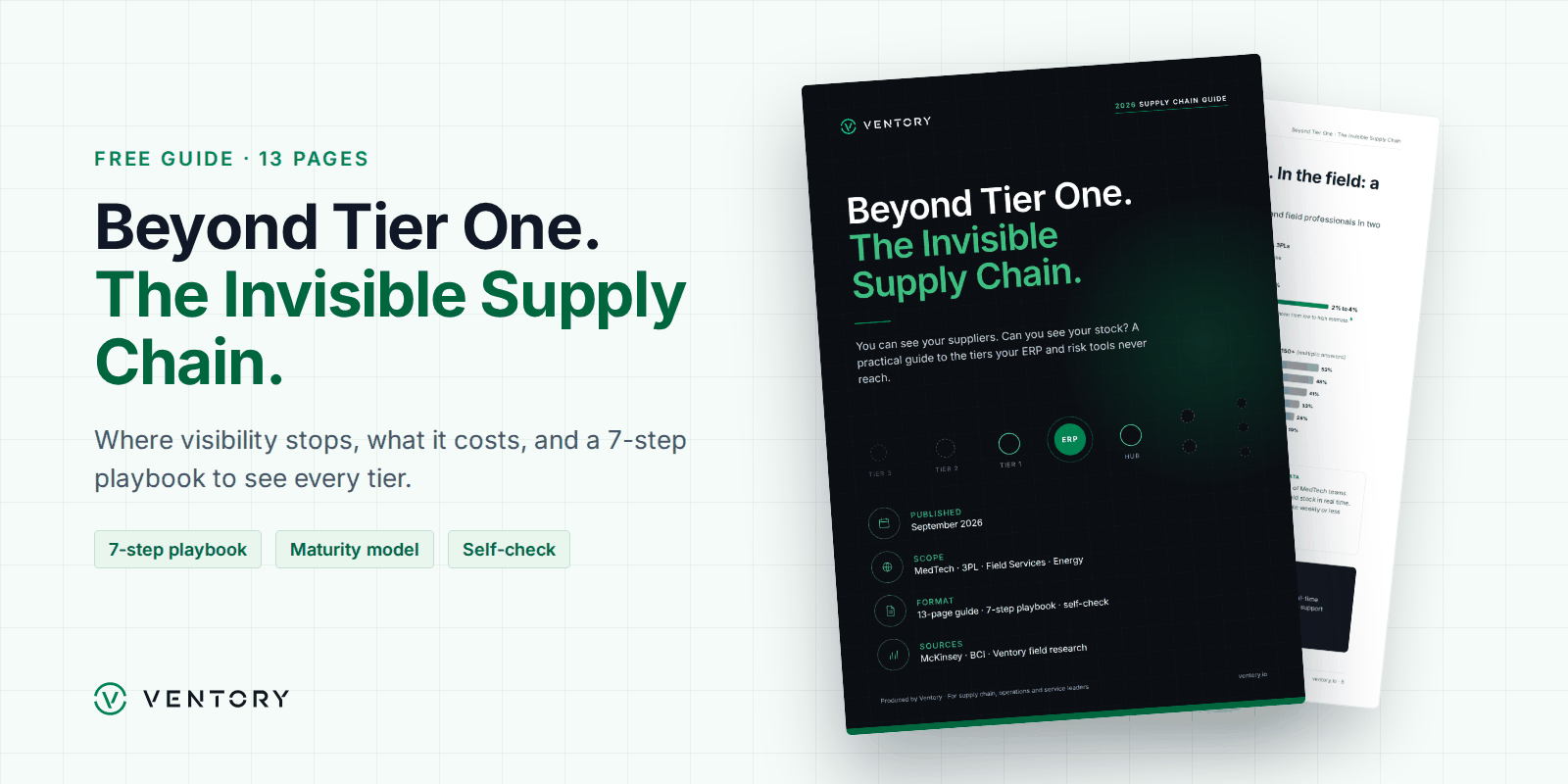
The full seven-step playbook, a maturity model and a ten-question self-check are in our free guide.
Download the guide: Beyond Tier One, The Invisible Supply Chain →
Field notes
- 95% of companies see tier-one supplier risk. 42% see further.
- A 99% accurate warehouse can sit next to a 63% accurate field.
- Most emergency freight moves stock you already own, from a place you cannot see.
See every tier
Bring one question to a 30-minute call: where is your most critical part right now? Book a demo and we will show you how to answer it for every location.
Frequently asked questions
What does supply chain visibility beyond tier 1 mean?
It means seeing risk and inventory past your direct suppliers. Upstream, that covers tier-two and tier-three suppliers. Downstream, it covers the stock that has left your warehouse and sits at field locations, customer sites and consignment accounts.
Why do most companies stop at tier one?
Tier one is where the contracts, the data and the direct relationships sit. Deeper tiers add parties and systems you do not control. McKinsey found that tier-one visibility keeps rising while visibility into deeper tiers has fallen two years in a row.
What are tier 3 locations in logistics?
In service logistics, tier one is the central warehouse, tier two the regional hub and tier three the places where stock is used: engineer vans, project sites and inventory at customer locations. ERPs and WMS are built for tiers one and two.
How much does poor field inventory visibility cost?
Ventory's research estimates $1.2M to $2.8M a year for a 3PL with 100+ field stock locations, and $750K to $1.55M for a MedTech organisation with 75 field reps. The biggest drivers are emergency freight, write-offs, SLA penalties and manual reconciliation.
Do we need to replace our ERP to see beyond tier one?
No. A field inventory layer sits between the ERP and the field. It captures movements where they happen and syncs them to the ERP you already run, so the ERP stays the financial system of record.
About Ventory
Ventory is the field inventory layer for regulated, high-stakes industries. We give MedTech, 3PL, Aerospace, Energy and FMCG leaders real-time visibility and control over inventory outside the four walls, in hospitals, ambulances, trunk stock, consignment locations, and field service vans. Ventory is ERP-agnostic (SAP, Oracle, Dynamics, Sage, NetSuite) and trusted by a national ambulance service, a global 3PL and a global consumer-goods company. See how it works →
Ten questions. You get a field readiness score, a gap tier and the three fixes worth doing first.

Ventory is the field inventory layer between your ERP or WMS and the teams working outside the warehouse: engineer vans, forward stocking locations, consigned stock and loaner kits.
About Ventory