Loaner kit tracking software for UK medical device companies: what NHS trusts expect, four failure points, eight must-haves and a fair comparison.
A loaner kit is the most travelled stock a medical device company owns. It leaves the distributor on Tuesday, lands in a hospital theatre store on Wednesday, goes through a procedure on Thursday, sits in the decontamination unit over the weekend and comes back the following week, if someone remembers to book the collection. Three organisations touch it. Nobody owns the count.
This guide is for UK commercial, operations and supply chain leaders who run loaner sets into NHS trusts and private hospitals. It covers what trusts expect from suppliers, the four points where tracking fails, what the software has to do, and a fair comparison of the options.
What a loaner kit is, and why nobody owns the count
A loaner kit (a loan set, in NHS language) is a set of instruments and implants supplied for a specific case, then returned. It is owned by the manufacturer or distributor, used by the trust, and reprocessed by the trust's decontamination unit (DU). Each party has its own record. The supplier has a dispatch note. Theatres have a tray form. The DU has a track-and-trace system with its own barcodes. Those three records rarely agree, and the gap only shows when a set goes missing, an implant is unbilled, or a tray arrives for a case with a part short.
The money is real. Loaner kit utilisation rates of 40-60% are cited in the MedTech Inventory Visibility Gap Report 2025, which also puts 20-30% of field inventory in the slow-moving or expired category. Half of every pound tied up in loan sets is sitting idle somewhere between the depot and the hospital, and the other half is hard to find.
What NHS trusts expect from a loan set in 2026
Trusts have tightened the rules. The Association for Perioperative Practice (AfPP) and the Institute of Decontamination Sciences (IDSc) published issue 2 of their loan set principles in July 2025. It sets out what theatres, decontamination units and suppliers each owe the process. The headline points for a supplier:
- Notice periods by day of use. Weekend and Monday requirements must reach the DU by Wednesday 1 pm at the latest. A set the DU does not recognise triggers a 24-hour notification so extra processing and training time can be planned.
- Documents with every set. A tray content sheet with product codes, a valid decontamination certificate, the manufacturer's reprocessing instructions (ISO 17664-1:2021) and an indemnity certificate.
- Track and trace on both sides. The DU generates unique barcodes per loan set and records them in its system. Suppliers are expected to run their own track-and-trace system and to collect after use.
- Returns are not instant. Sets go back to the DU on the next available transport, are fully decontaminated, certified, and only then released for collection. The document sets a minimum of 23 hours after use unless local policy says otherwise.
On top of that sits Scan4Safety, the NHS England programme that uses GS1 standards to scan patients, products, places and processes at the point of care. The programme's own figures: the six original demonstrator trusts achieved recurrent inventory savings of nearly £5 million over two years, and NHS Supply Chain estimates an average benefit of £2.7 million per trust over five years. For a supplier the consequence is simple. Every implant scanned into a patient record at the trust is a data point you must match against your own count. If you cannot, the trust's record wins the argument.
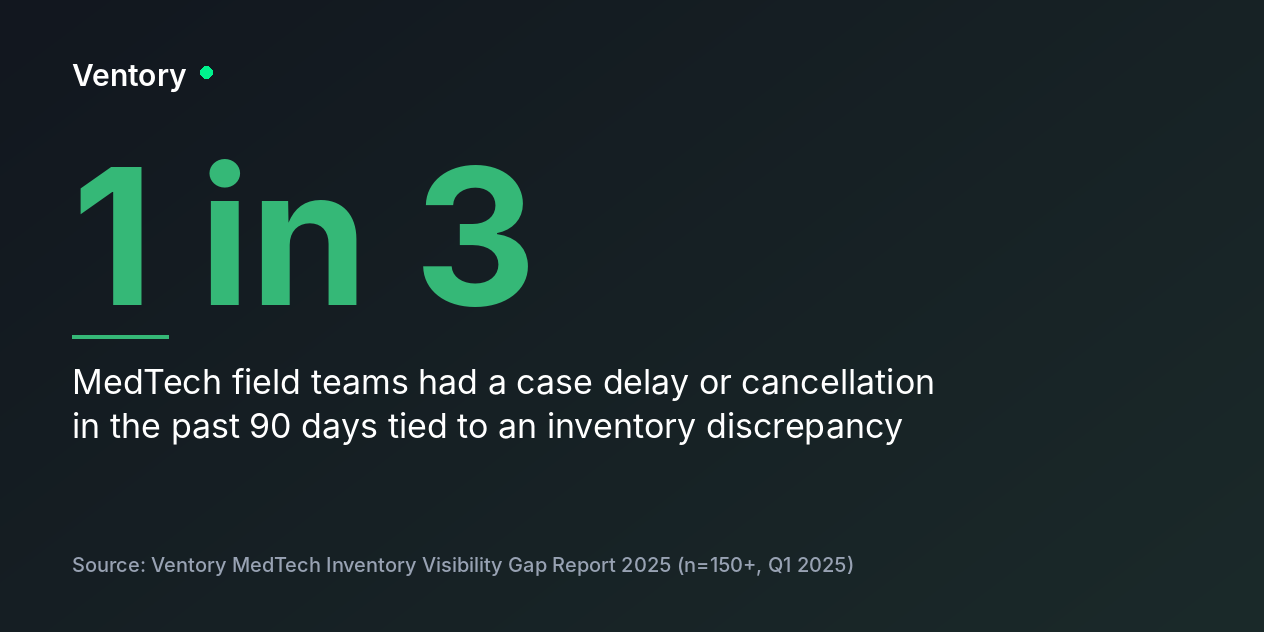
The cost of not matching lands in theatre. In the MedTech Inventory Visibility Gap Report 2025, a Ventory survey of 150+ field inventory leaders across EMEA, North America and APAC, 1 in 3 respondents reported a case delay or cancellation in the past 90 days tied directly to an inventory discrepancy. 68% still confirm stock before a case by call, text or spreadsheet.
The four failure points
Loaner tracking fails at four handovers. Each one has a different owner, which is why a single spreadsheet never fixes it.
1. Request
The surgeon's secretary emails the rep. The rep texts the depot. The depot checks a spreadsheet last updated on Friday. Nobody has booked the set against the case date, so two reps promise the same tray to two hospitals. The AfPP notice periods assume the supplier can confirm availability on the day. Without a live booking calendar per set, it cannot.
2. Dispatch
The set leaves with a dispatch note that lists the tray, not the contents. Implant lots and expiry dates travel on the box label, not in the system. When the DU scans the set in and finds a part short or an implant inside its last 30 days of shelf life, the supplier hears about it the morning of the case.
3. Return
The procedure ends. The set sits in theatre, then in the DU queue. The return deadline exists in a contract, not in a system that alerts anyone. Weeks later the depot wonders why a set shows as available in the spreadsheet but is physically in a hospital 200 miles away. Consumed implants from that set are often still unbilled, because the usage record lives on a paper tray form.
4. Reprocess
The set comes back. Complete? Anything swapped with another tray in the DU? Due an inspection after so many cycles? Without a set-level cycle count and condition check on return, every set is cleared for the next case on trust, not on data.
What loaner kit tracking software must do
Any tool that claims to track loan sets should pass these eight tests. If it fails more than two, it is a dispatch log, not tracking software.
- Serial and lot per set. Every instrument serial and every implant lot inside the kit, not just a tray number. When a lot is recalled, you need the list of trusts that held it in minutes.
- Expiry per implant. Expiry alerts at 90, 60 and 30 days, so a set never goes out with an implant that will expire before the case.
- Location at every handover. Depot, courier, theatre store, DU, back at depot. Scanned, with a timestamp and a person.
- Booking against the case. A set is reserved for a hospital and a date. Double bookings are blocked, not discovered.
- Return deadlines with alerts. A countdown per set, and an alert to the rep and the depot when a set is overdue.
- Usage capture at the point of care. Scan the UDI of each consumed implant in theatre. That scan is the billing trigger and the replenishment trigger.
- ERP sync, not ERP replacement. Bookings, consumption and returns flow to SAP, Microsoft Dynamics, Oracle, NetSuite or Exact. The ERP stays the system of record for stock value and invoicing.
- Offline on a phone. Theatre stores and DU corridors have poor signal. The app must scan offline and sync later.
Two more points matter in the UK specifically. First, the software should accept the DU's GS1 barcodes as well as the supplier's own labels, so a set can be identified by either side without relabelling. Second, it should produce the tray content sheet with product codes automatically from the kit record, because that document is now expected with every delivery.
At a glance: four ways companies track loaner kits today
There is no single right answer. A distributor with 40 sets and three trusts has a different problem from a manufacturer with 1,200 sets across the UK and Ireland. The table judges each approach on the same criteria.
| Approach | Who owns the count | Serial, lot and expiry per set | Return deadlines and reprocessing status | ERP sync | Best for |
|---|---|---|---|---|---|
| Spreadsheet and WhatsApp | Whoever updated it last | Rarely below tray level | Manual chasing, no alerts | None, re-keyed | Under 50 sets, one or two trusts, low implant value |
| ERP only (SAP, Dynamics, Oracle) | Finance, at the warehouse | Lot and serial at goods issue, usually lost in the field | Not modelled; a set is just a stock transfer | Native, but only to the point of dispatch | Companies whose sets rarely leave a single depot |
| Hospital-side tray tracking (DU track and trace) | The trust | Yes, from the DU barcode, in the trust's system | Reprocessing status is excellent; return to supplier is not its job | To the trust's systems, not the supplier's | Trusts; suppliers get a certificate, not visibility |
| Field inventory layer (Ventory and similar) | Supplier, shared with the rep and the trust | Yes, per set, scanned at every handover | Alerts per set, cycle counts and condition checks on return | Two-way with the ERP, which stays the system of record | 50+ sets across multiple trusts, implants with expiry, bill-on-use |
Judged honestly, the field inventory layer is the only approach built for the supplier's side of the problem. It is also the only one that costs a subscription and 4-8 weeks of implementation. Hospital-side systems are good at their job and are not going away: the right design integrates with them. A spreadsheet is fine until the first unbilled implant costs more than a year of software.
How to pick
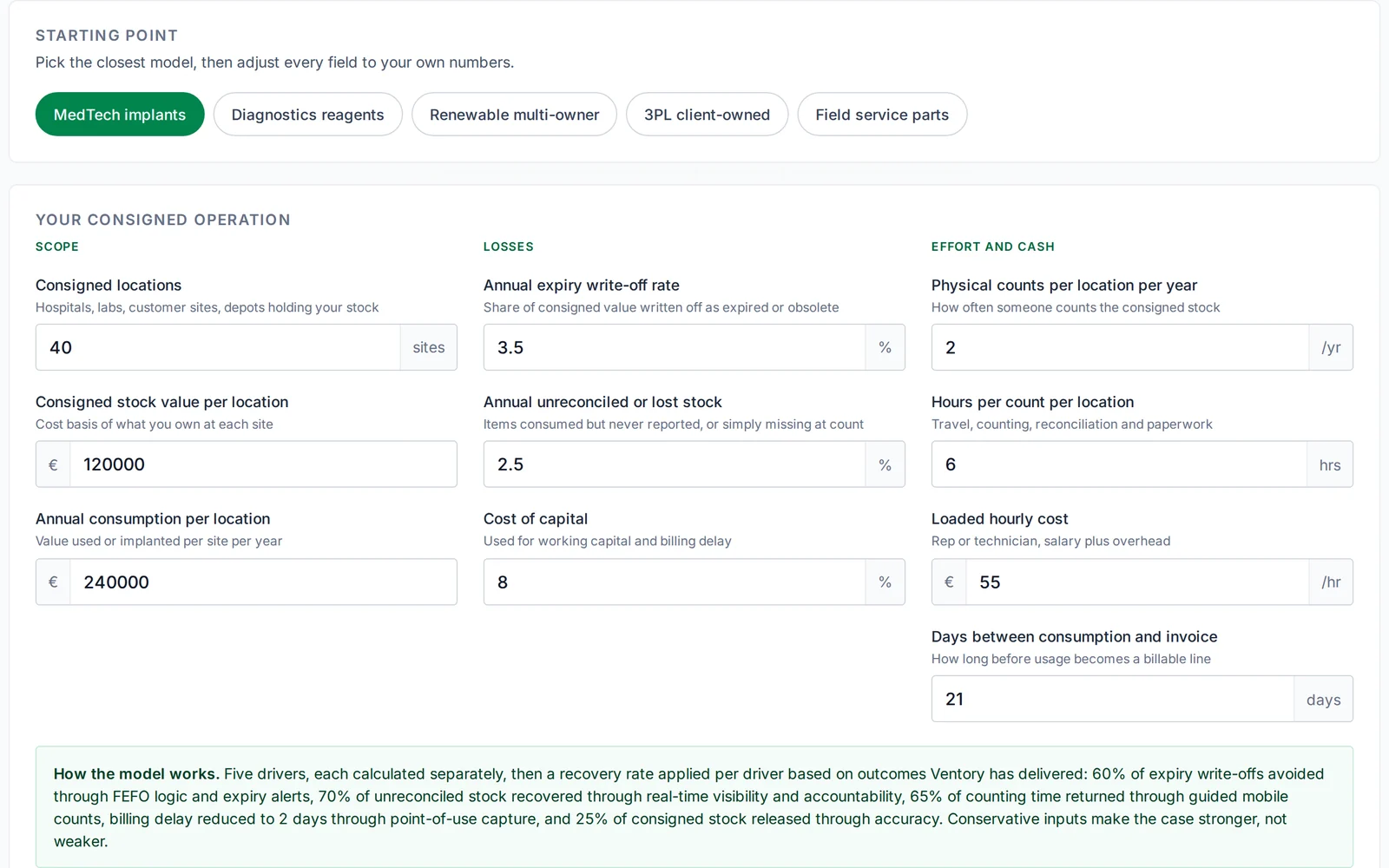
Start with your own numbers, not a vendor demo. Count your sets, your trusts and your implant value per set. Run the Consigned Stock P&L calculator to put a figure on expiry, loss and unbilled usage for one year. If that number is below the cost of software, keep the spreadsheet and fix the return discipline.
If it is above, work through the Vendor Evaluation Checklist. It covers the eight tests above plus security (ISO 27001, SOC 2, GDPR), ERP integration references and three-year cost. The three-minute Ventory Fit Check tells you whether a field inventory layer fits before anyone books a call. The whitepaper Loaner Kits and Rep Devices covers loan sets and rep devices as one process.
Related reading: Loaner kit management: the hidden bleed in MedTech supply chains, the 2026 guide to consignment inventory management and EUDAMED and UDI software compared. For how the pieces fit into one system, see medical device inventory software and the product expiry management use case.
Frequently asked questions
What is loaner kit tracking software?
Software that records every loan set by serial and lot, books it against a case, tracks its location through dispatch, theatre, decontamination and return, captures implant usage at the point of care and syncs the result to the ERP. It sits between the supplier's ERP and the hospital's systems and gives the supplier its own count.
What do NHS trusts expect from a supplier of loan sets?
The AfPP and IDSc loan set principles (issue 2, July 2025) expect suppliers to confirm details and dates, deliver with a tray content sheet, decontamination certificate, reprocessing instructions and indemnity certificate, run their own track-and-trace system and collect sets after use. Notice periods run by day of use, with weekend and Monday sets notified by Wednesday 1 pm.
Can an ERP such as SAP or Dynamics track loaner kits on its own?
An ERP tracks the set to the point of dispatch and back at goods receipt. It does not model bookings per case, return deadlines, reprocessing status or implant usage in theatre. Most companies that try it end up with a spreadsheet next to the ERP. A field inventory layer adds the missing steps and keeps the ERP as the system of record.
How does Scan4Safety affect loaner kit suppliers?
Scan4Safety trusts scan implants into patient records at the point of care using GS1 barcodes. The trust therefore holds a precise usage record per set. Suppliers need an equally precise count to reconcile consumption, billing and returns, or the trust's record becomes the only version of the truth.
How long does it take to deploy loaner kit tracking?
Ventory deployments go live in 4-8 weeks, including ERP integration, kit master data and rep training. The critical path is usually the kit master data: a clean list of sets with their serials and lots. Companies that already hold that list in the ERP go faster.
Getting started
Running loan sets on a spreadsheet while trusts tighten their rules? See how a field inventory layer gives you the count across every set, every trust and every lot. Book a demo.
Sources
- AfPP and IDSc, Loan Set Management and Individual Medical Devices: Principles Between Suppliers/Manufacturers, Theatre Departments and Decontamination Units, issue 2, July 2025: afpp.org.uk
- NHS England, What is Scan4Safety?: scan4safety.nhs.uk
- Ventory Research, MedTech Inventory Visibility Gap Report 2025: ventory.io (PDF)
Ten questions. You get a field readiness score, a gap tier and the three fixes worth doing first.

Ventory is the field inventory layer between your ERP or WMS and the teams working outside the warehouse: engineer vans, forward stocking locations, consigned stock and loaner kits.
About Ventory