Only 36% of supply chain leaders achieve real-time visibility. The components and builds that close the gap.
Most inventory tracking stops being real time at the loading dock
Every vendor selling real time inventory tracking software makes the same promise: each stock movement is recorded the moment it happens, so the number in the system always matches the number on the shelf. Inside a warehouse, plenty of tools keep that promise. The moment stock leaves for a van, a client site or a forward stocking location, most of them quietly stop, because the promise depends on field inventory management capability they never built. If you are evaluating software as a Head of Operations or Inventory Manager, that distinction should shape the whole shortlist.
We have written separately about why real-time inventory visibility matters to the business; this post is about the machinery that produces it. What real time inventory tracking software actually consists of, the three ways companies build it, when each fits, and the limits vendors tend to leave out.
What real time inventory tracking software actually is
Real time inventory tracking software records every receipt, movement, count and consumption as an event at the moment it happens, and updates one shared stock position within seconds. The contrast is batch tracking: paper or spreadsheet records typed in later, nightly ERP jobs, weekly cycle counts. Under batch tracking your system is not wrong exactly, it is late, and late is enough to reorder stock you already have and promise stock you no longer hold. Vendors use real time inventory management software and real time inventory tracking interchangeably for the same category; the label matters less than where the updates are created, which is the part this post keeps returning to.
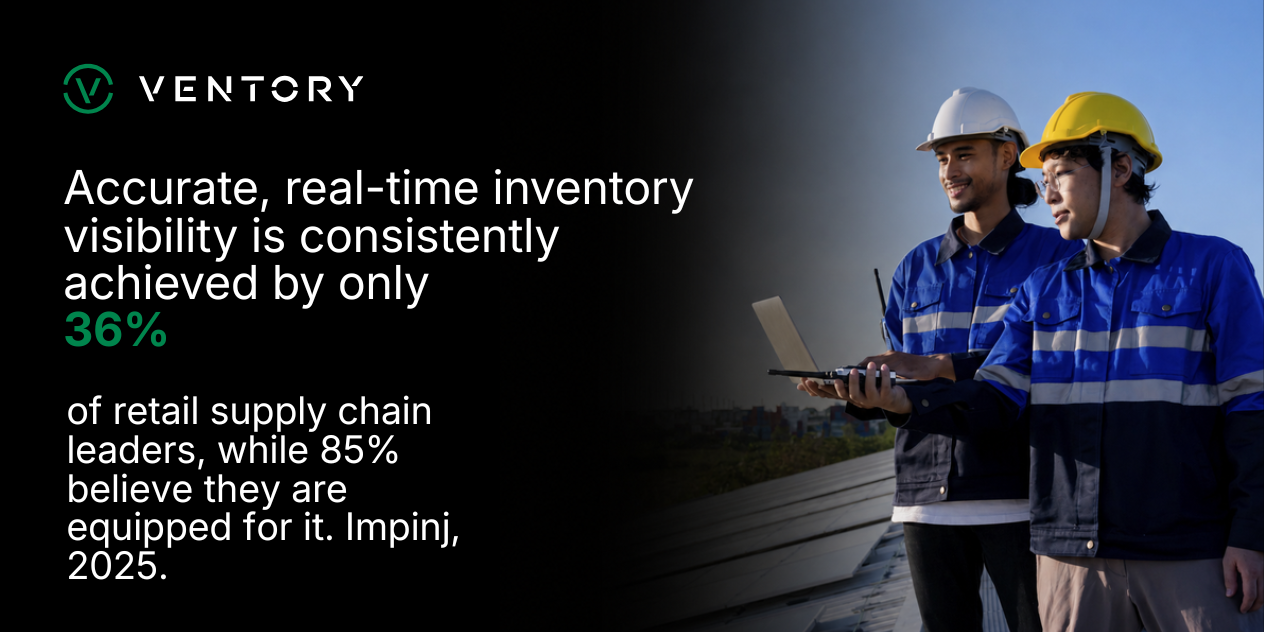
The gap between what companies claim and what they achieve here is measurable. According to Impinj's 2025 State of Supply Chain Integrity report, only 36% of retail supply chain leaders say they consistently achieve accurate, real-time inventory visibility, while 85% believe their organization is equipped to do so. That 49-point gap is rarely a sensor problem. It is an architecture problem: updates are captured somewhere other than the point where stock actually moves.
The four components that separate real time from batch
Strip away the marketing and real time tracking is four capabilities working together. Miss any one of them and you are back to batch with a nicer dashboard.
1. Scan events at the point of action
The update has to be created where the stock moves: a technician scanning a part out of the van shelf, a nurse scanning an implant out of a cabinet, a warehouse operator scanning a pallet into a bin. Any workflow that ends with someone typing movements into a screen back at a desk is batch tracking with extra steps. In practice this also means the software must read the barcodes already on the item, whether that is a manufacturer code, a GS1 label, a lot number or a serial, without a relabelling project first; that is what multi-barcode scanning exists for.
2. Offline capture with reliable sync
Basements, hospital corridors, rural substations, underground parking and metal-clad plants all have one thing in common: no dependable signal. Real time does not mean permanently connected. It means the event is captured at the moment of action, queued on the device, and synced in the right order the moment a connection returns, with conflicts resolved instead of silently dropped. Software that simply refuses to work offline trains field teams to write things down for later, and later is where accuracy dies.
3. ERP integration in both directions
Your ERP stays the system of record for finance and procurement, so the tracking layer has to push every stock event into it and pull item masters, locations and order data out of it, through proper systems integrations rather than CSV exports on a schedule. A tracking tool that does not write back to the ERP is not adding real time visibility; it is adding a second version of the truth for your team to reconcile.
4. A location model that matches where stock actually sits
Most tracking tools model warehouses, zones and bins. Real operations also hold stock in engineer vans, at client sites, in consignment cabinets, at forward stocking locations and in transit between all of them. If the software cannot treat a van as a first-class stocking location with its own levels, movements and counts, everything outside the warehouse becomes a memo field. We cover how to structure this in our guide to multi-location inventory management.
Three ways to build it, and when each fits
Every real time tracking setup we see in the field is one of three architectures, each with a legitimate use case and a real limit:
- The ERP inventory module. Best when your stock sits in facilities that already run the ERP, with terminals, network coverage and trained power users. The limits are practical: per-user licensing makes it expensive to put in every field worker's hands, the screens are built for specialists rather than a technician with gloves on, and offline support is usually thin. Extending it to vans and client sites is where the ERP visibility gap opens up.
- The warehouse-grade tracker. A WMS-class system built for high-volume distribution centres: bin-level control, wave picking, labour management, RF guns. If your problem is throughput inside the four walls, this is the right tool. Its limit is scope, not quality: it is priced, installed and designed per facility, so vans, client sites and forward stocking locations sit outside its model.
- The field inventory layer. An app-first tracking layer that runs on the phones your field teams already carry, treats vans, client sites and forward stocking locations as real locations, captures scans offline, and syncs everything back to the ERP. Its limit is equally honest: it is not a WMS and will not run wave picking or dock scheduling. It complements the ERP rather than replacing it, and it earns its keep only if a meaningful share of your stock lives outside the four walls.
At a glance
| Approach | Best for | Field coverage |
|---|---|---|
| ERP inventory module | Facilities already running the ERP with trained users | Low: assumes terminals, network and per-user licences |
| Warehouse-grade tracker | High-volume distribution centres inside the four walls | Partial: per-facility design leaves vans and client sites outside |
| Field inventory layer | Stock in vans, client sites and forward stocking locations | Full: phone scanning, offline capture, syncs to the ERP |
What the field inventory layer looks like in practice
Ventory is built as that third option. Field teams scan any barcode on any smartphone, online or offline, and every event flows into the ERP as it happens, so the stock position in SAP, Oracle, Dynamics, Sage or NetSuite reflects the van shelf and the consignment cabinet, not just the warehouse. Operations tracking field stock this way reach 99.76% inventory accuracy, and across deployments customers typically see up to 70% fewer stockouts and around 30% higher field productivity, with rollouts live in 2 to 3 months because there is no hardware to install and no relabelling project to run first.
The honest framing matters here too: if all of your stock sits in one warehouse, an ERP module or a warehouse-grade tracker will serve you well and Ventory is not the tool to start with. The field inventory layer wins when the expensive mistakes happen outside the building.
Field notes
- Judge any real time claim by one question: where is the update created? If the answer is a desk, it is batch tracking on a delay.
- Test offline behaviour before you buy. Put a demo device in airplane mode, record ten movements, reconnect, and check the order and completeness of what syncs.
- Count your stocking points, including every van and client site. If more than a handful sit outside the warehouse, evaluate field coverage first and warehouse features second.
Evaluating real time inventory tracking software for stock that lives in vans, client sites or forward stocking locations? Book a demo and see a scan travel from a field location into your ERP while you watch.
Frequently asked questions
What is real time inventory tracking software?
Software that records every stock movement as an event at the moment it physically happens, usually by barcode scan, and updates a single shared stock position within seconds. The defining test is not the dashboard refresh rate but where updates are created: at the point of action, or typed in afterwards.
Is real time inventory management software the same thing?
In practice, yes. Vendors use real time inventory management software, real time inventory tracking and live inventory tracking to describe the same category. Whatever the label, evaluate the same four components: scan events at the point of action, offline capture with sync, two-way ERP integration, and a location model that covers vans, client sites and forward stocking locations.
Does real time inventory tracking work offline?
It has to, or it is not real time in the places that matter. Good software captures the scan on the device the moment stock moves, queues it locally, and syncs events in order once a connection returns. Software that blocks work without signal pushes field teams back to notes and memory, which is exactly the failure mode you bought it to fix.
Do I need to replace my ERP to get real time tracking?
No. The ERP remains the system of record; the gap is usually capture, not record-keeping. An integrated tracking layer feeds the ERP scan events from the locations it cannot see, which is a far smaller project than an ERP migration and leaves finance and procurement workflows untouched.
Related reading
- Multi-location inventory management: one stock position across warehouses, vans and client sites
- The ERP visibility gap: why field stock needs its own inventory layer
About Ventory
Ventory is the field inventory layer for regulated, high-stakes industries. We give MedTech, 3PL, Aerospace, Energy and FMCG leaders real-time visibility and control over inventory outside the four walls, in hospitals, ambulances, trunk stock, consignment locations, and field service vans. Ventory is ERP-agnostic (SAP, Oracle, Dynamics, Sage, NetSuite) and trusted by a global medtech manufacturer, a national ambulance service, global logistics and consumer-goods operators. See how it works →
Ten questions. You get a field readiness score, a gap tier and the three fixes worth doing first.

Ventory is the field inventory layer between your ERP or WMS and the teams working outside the warehouse: engineer vans, forward stocking locations, consigned stock and loaner kits.
About Ventory